Have you ever felt stuck with a dead car motor? An engine hoist is a fluid pump tool that lifts heavy weights for you. I have pulled many motors over the years. Knowing how an engine hoist works stops the panic fast. A two ton lift fits well in most US home shops. Read on to learn how to use it safely.
What Is an Engine Hoist, Really? (And Why People Use One)
I still remember standing in my cramped garage a few years back. The heavy smell of old 10W-30 motor oil hung in the air. I was staring down at a massive, dead V8 engine. I wiped the grease off my hands and thought, “There is no way I am lifting that.”
If you have ever felt that exact same panic, take a deep breath. This is where the engine hoist saves the day.
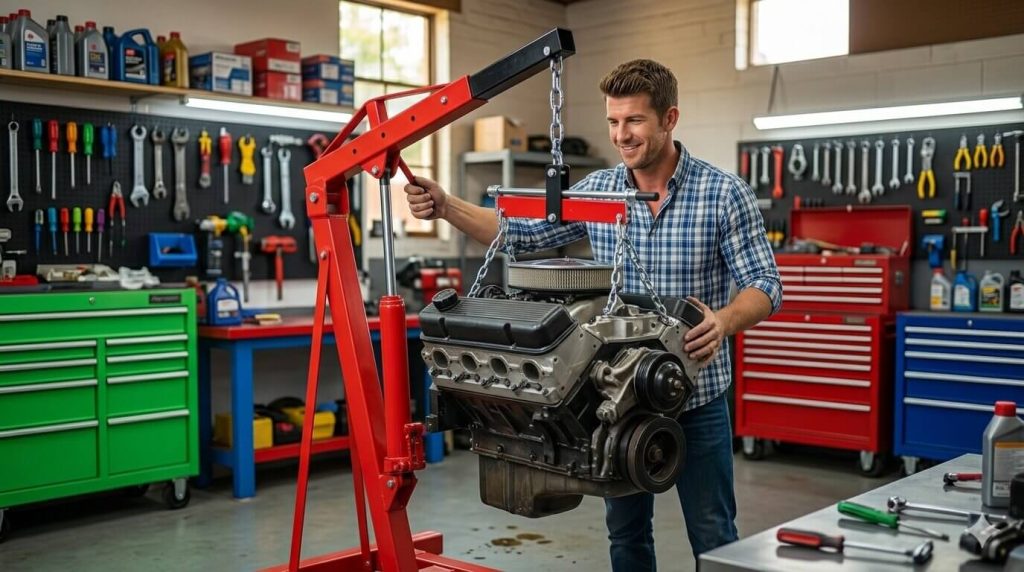
In the simplest terms, an engine hoist is a hydraulic lifting tool. We use it to safely remove or install heavy car engines. You might also hear older mechanics call it an “engine crane” or a “shop crane.”
You will see these tools everywhere. They sit quietly in home garages on lazy Sunday afternoons. You also find them working hard in busy, professional auto shops.
When you are working alone and need to pull a motor, human muscle is not enough. You need help. The hoist becomes your best friend.
What Makes an Engine Hoist Different from Other Lifting Tools
When I first started turning wrenches, I asked a silly question. “Why not just use my floor jack?” Well, I tried to get creative once. Trust me, it does not work.
Here is why an engine hoist stands out from the rest of your garage gear:
- Compared to floor jacks: A standard jack only pushes straight up from the bottom. It has a very short reach. You use it to lift a car up to change a tire. You cannot use it to reach deep under a hood and pull a motor out.
- Compared to chain blocks: Chain blocks are great for lifting, but they have one huge flaw. They need strong overhead support. If your garage ceiling is weak, a chain block might rip the roof beams right down on your head. (I almost learned that the hard way!)
- Why hoists win: An engine hoist gives you total mobility and flexibility. It rolls on strong wheels. You can lift the motor up, step back, and roll the whole heavy mess away safely.
To make it easy, here is a quick breakdown of how these tools compare:
| Lifting Tool | Best Used For | The Biggest Weakness |
| Engine Hoist | Pulling and moving car engines | Needs clear, flat floor space to roll |
| Floor Jack | Lifting a car from underneath | Only moves a short distance straight up |
| Chain Block | Heavy, stationary overhead lifting | Requires a very strong garage ceiling |
Once you understand what the tool does, the whole job feels much less scary. The hoist handles the heavy weight, so you can focus on the fun part of fixing the car.
The Basic Principle — How an Engine Hoist Actually Works
Let me take you back to a hot Tuesday afternoon. I was sweating in my driveway, staring at a greasy block of metal. I really wanted to understand how an engine hoist actually works before I trusted it with a 500-pound motor.
At its core, it is just simple physics doing the heavy lifting. It uses a little bit of hydraulic magic to save your back.
The main idea is brilliant but simple. It takes a very small push from you. Then, it turns that tiny push into a giant lifting force. It mixes fluid pressure with basic leverage to get the job done safely.
The Core Mechanism (In Plain English)
Here is the core setup in plain English. We will skip the hard science terms here. When I grab that cold metal pump handle and push down, a clear chain of events starts.
- The Handle: You pump the handle down. This pushes thick oil into a small tube.
- The Pressure: The oil has nowhere to go. It builds high pressure inside the main round cylinder.
- The Push: Because of the pressure, the cylinder slowly stretches outward. This forces the long boom arm to rise up toward the roof.
- The Lift: The rising boom pulls the heavy engine up into the air using a strong steel chain.
Why It Feels “Easy” to Lift Something So Heavy
You might wonder why it feels so easy to lift a huge, heavy motor. I was totally shocked the first time I tried it. I expected a massive workout, but I hardly broke a sweat.
This happens because of a neat science rule called Pascal’s Law. I will skip the boring jargon so your eyes do not glaze over. Basically, liquid inside a closed pipe cannot be squeezed smaller. If you push a little bit of liquid in a tight space, it can push a huge weight in a larger space. It creates extreme force multiplication.
Think about it with a relatable analogy. Have you ever tried to loosen a rusted bolt with a tiny, stubby wrench? It hurts your hand, and the bolt stays completely stuck. But, if you grab a two-foot-long wrench, the bolt pops loose right away. The long bar boosts your natural force.
The engine hoist does the exact same thing. It uses long metal arms and trapped fluid to multiply your strength.
Here is a simple look at how your light work creates heavy lifting:
| What You Do | What Happens Inside | The Final Result |
| Pump the handle down | Fluid gets forced into the main tube | Pressure builds up fast |
| Keep a steady rhythm | The thick hydraulic ram pushes out | The long boom arm rises |
| Stand back and watch | The hoist takes all the heavy weight | The engine comes out easily |
This is why you do not need giant muscles to pull a car motor. The hoist acts like a massive set of mechanical muscles for you.
Key Parts of an Engine Hoist (And What Each One Does)
The first time I rented an engine hoist, it arrived in pieces. It was a chilly Saturday morning. I stood in my driveway, shivering. I looked at this giant pile of heavy, yellow metal. I felt a tight knot in my stomach. What did all these heavy chunks of steel actually do?
Once you learn the parts of an engine hoist, everything changes. The panic fades away fast. Knowing the parts makes the whole job much less scary. More importantly, it keeps you totally safe.
The Main Components You’ll Notice First
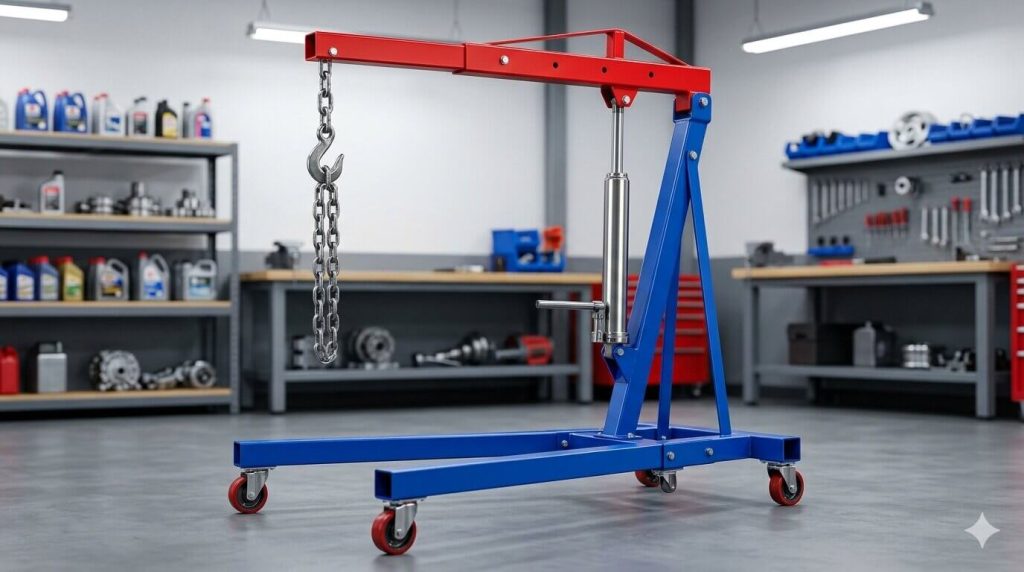
When you finally bolt the hoist together, a few big parts stand out right away. These are the main pieces that do the heavy lifting.
- The Boom: This is the long lifting arm at the top. It reaches far out over your car hood to grab the motor.
- The Hook and Chain: This heavy metal chain dangles from the end of the boom. You bolt the chain directly to your engine block. You will hear a loud metal clank when it drops against the motor.
- The Hydraulic Ram: This thick, silver tube is the true muscle. It sits in the middle of the frame and pushes the long boom up into the air.
- The Legs and Base: These long metal beams slide out at the very bottom. They give you a wide stance and total stability so the tool does not tip over.
- The Casters: These are the heavy-duty steel wheels. They let you push the massive weight across your rough concrete garage floor.
The Parts People Ignore (But Shouldn’t)
I see a lot of beginners focus only on the big, shiny parts. But the smaller parts are what keep you alive. I learned this the hard way when a motor tilted on me suddenly. My heart almost stopped in my chest!
Pay close attention to these pieces:
- The Release Valve: This is a tiny screw knob near the bottom pump. You turn it to let the engine down. You must turn it very slowly. If you twist it too fast, the engine drops like a heavy rock.
- The Load Leveler: This is an extra tool, but it is super powerful. It hooks between the chain and the boom. It has a hand crank. You turn the crank to tilt the motor safely as you pull it out of tight spots.
- The Pin Settings: Look closely at the boom arm. You will see holes with thick steel pins. You must set the pin to match your exact engine weight. If you pull a heavy truck motor on the wrong setting, the arm could bend.
To make it super easy, I made a quick cheat sheet for you:
| Hoist Part | What It Actually Does | Why You Must Check It |
| Hydraulic Ram | Pushes the boom up | Look for messy oil leaks before lifting |
| Release Valve | Lowers the engine down | Keeps the drop smooth, slow, and safe |
| Pin Settings | Adjusts the weight limit | Stops the boom arm from bending |
| Base Legs | Stops the hoist from falling | Must lock in place tightly before use |
When you know exactly what every part does, you gain instant confidence. You stop fighting the tool and let it do the hard work for you.
How the Hydraulic System Works (Without the Engineering Headache)
I used to think the hydraulic system was some crazy, complex machine. One late Wednesday night, I was sitting on my garage floor. I was staring at the shiny silver tube on my engine hoist. My hands were covered in sticky grease. Suddenly, it clicked in my head. This is the “hidden brain” of the hoist.
Honestly, it is much simpler than it sounds. You do not need a college degree to understand it.
What Happens Inside the Cylinder
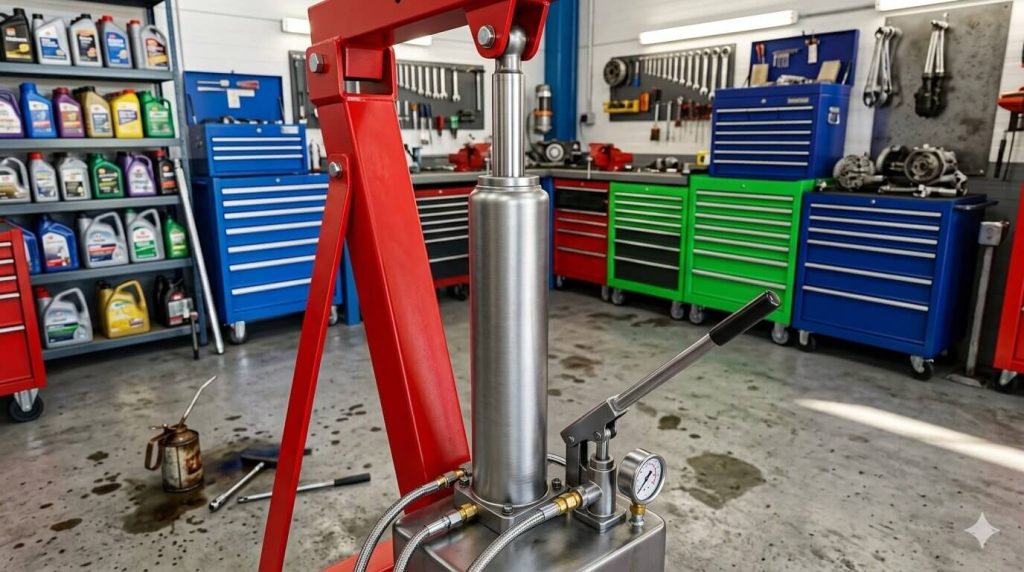
Let me break down what actually happens inside that thick steel tube. It is a very simple chain reaction.
- Fluid displacement: When you pump the handle, you push thick oil from a small cup into a main chamber. If you listen closely, you can actually hear a faint squishing sound as the oil moves.
- Pressure buildup: This fluid has nowhere else to escape. Because it is trapped, it builds up massive pressure inside the strong metal walls.
- Controlled extension: That trapped pressure pushes hard against the main steel rod. The rod has to move up. It slides out in a very smooth, controlled way.
Why Hydraulic Systems Are Used Instead of Springs or Motors
You might ask why we do not just use giant metal springs or heavy electric motors. I asked that exact same thing before I saw a hoist in real life.
- Smooth lifting: Springs are very bouncy. Imagine a heavy, swinging engine bouncing wildly up and down over your nice car fenders. No thanks! The hydraulic system gives you a perfectly smooth, gliding lift.
- Precision control: When I need to drop an engine onto the motor mounts, I need it to move a tiny fraction of an inch. An electric motor can be jerky. The hydraulic valve lets me lower the heavy metal like a soft feather.
- Reliability: There are very few moving parts inside. As long as there are no fluid leaks, the tool works every single time you need it.
Here is a quick look at why hydraulics win the battle every time:
| Lifting Method | How It Behaves | Why It Works (or Fails) for Engines |
| Hydraulic System | Smooth and steady | Best choice. Gives you total precision and safety. |
| Giant Springs | Bouncy and wild | Terrible idea. One snap and things get smashed. |
| Electric Motors | Fast but sometimes jerky | Hard to lower the motor safely in tight spaces. |
Once you see the magic of fluid pressure, you stop worrying. You realize the tool is built to keep you completely safe.
Common Mistakes Beginners Make (And How to Avoid Them)
This is where things usually go wrong. Sometimes, they go wrong very loudly.
I want to save you from the mistakes I made. When you are tired, you rush. I rushed once on a busy Saturday night. I wanted to finish my project so badly. I ignored my own rules and made some dumb choices.
Here are the biggest traps to avoid with an engine hoist:
- Overloading the hoist: Never guess the engine weight. I almost lifted a heavy iron block on the weakest boom setting. The metal arm actually groaned. Always check your weight limits first.
- Not locking the boom position: You slide the lifting arm out to reach the car. Then, you forget to put the thick steel pin back in. The arm can snap or slide back under a heavy load. That is super dangerous.
- Uneven weight distribution: If your chains are not centered right, the engine will swing hard. When it lifts off the mounts, it acts like a giant, greasy pendulum.
- Ignoring the floor surface: A sloped garage floor is a bad idea. I tried to pull a motor on my tilted driveway once. The loaded hoist started rolling downhill! I had to grab the frame and brace my boots against the concrete. Keep it on a flat, level floor.
Real-Life Scenario
Let me share a very scary moment. I had my old motor high up in the air. I noticed it was tilting mid-air. I decided to lower it just a little bit to fix the chain balance.
My hands were slick with cold, black grease. I grabbed the small release valve. Instead of a slow turn, my hand slipped. I twisted it way too fast.
The massive engine dropped two feet in a split second. The chains slapped together with a loud, ringing crack. My stomach dropped right down to my shoes. I froze.
In that moment, I wanted to panic. But panic makes it worse. If you yell and yank on the machine, you might tip the whole thing over. I took a deep breath, twisted the valve shut, and checked my base.
Here is a quick guide to help you handle these common errors without the stress:
| The Beginner Mistake | What Happens | How You Fix It Fast |
| Uneven Chains | The engine tilts and swings wildly | Lower it fully and move the hook to center |
| Fast Valve Drop | The load falls down very quickly | Twist the knob right to close the valve instantly |
| Sloped Floor Setup | The heavy hoist rolls away from you | Stop the job and move to flat, level concrete |
| Wrong Boom Pin | The metal lifting arm groans or bends | Match the pin hole to your exact engine weight |
Learn from my sweaty, stressful moments. Go slow, check your setup twice, and stay calm.
Safety Tips That Actually Matter (Not Just Generic Advice)
Let’s be honest. Reading safety rules can feel boring. But when you are using an engine hoist, this part is not optional. It is the real difference between a smooth job and a total disaster.
I learned this on a very long Friday night. My back ached, and I was exhausted. I just wanted to finish pulling the motor so I could go to sleep. I almost skipped my safety checks. Luckily, I caught myself before I made a huge mistake.
Here are the rules I live by now to keep myself safe:
- Always double-check chain connections: I never trust the first bolt. I grab the heavy, cold steel links and yank them hard. If they slip even a tiny bit, I take them off and start over.
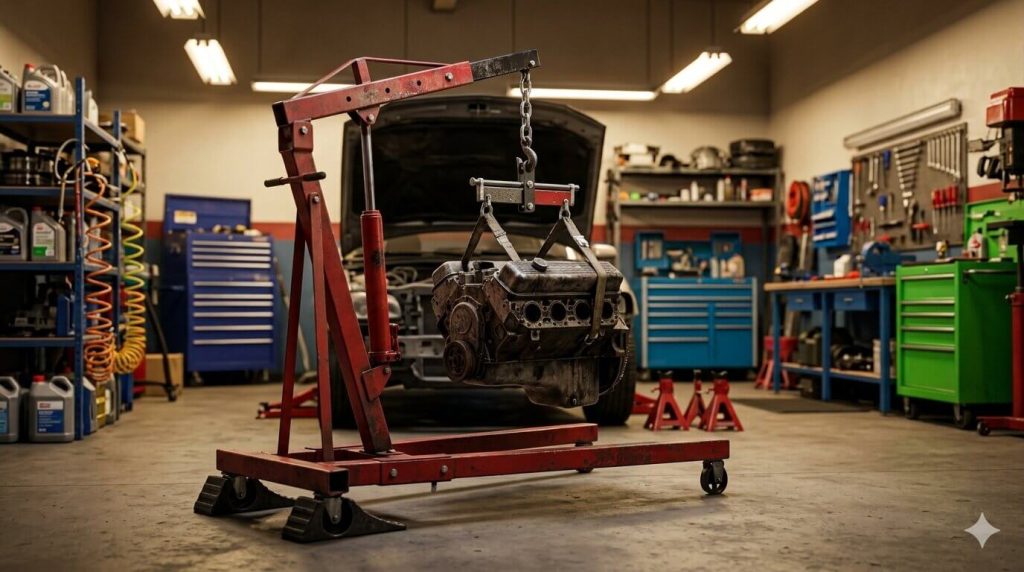
- Never stand under the engine: This sounds obvious, right? But sometimes a stray wrench rolls right under the suspended motor. Leave it there! I never put my hands, feet, or head under that floating block of iron. If a chain snaps, you cannot catch it.
- Use jack stands alongside the hoist: Sometimes you need to lift the car body while the hoist holds the motor. Never trust just a hydraulic floor jack. Always put strong metal jack stands under the car frame first.
- Lower slowly—always: I treat that small release valve like it is made of thin glass. I pinch it gently with two fingers and twist it softly.
A Quick Mental Checklist Before Lifting
I use a simple routine now. Right before I pump the handle for the first time, I pause. I wipe the sweat off my forehead, look at the tool, and do a quick mental check.
I actually run through this exact list in my head:
| The Question I Ask | Why I Need to Ask It | My Quick Check |
| Is the weight okay? | An overloaded tool bends or breaks. | Weight is well under the limit. ✔ |
| Is the load balanced? | A tilted motor swings hard and fast. | Chains are perfectly centered. ✔ |
| Is my space clear? | Tripping over messy tools is a bad idea. | Garage floor is totally clean. ✔ |
| Is my exit path planned? | Once the heavy tool rolls, you cannot stop easily. | Route to the engine stand is clear. ✔ |
When you respect the tool, it respects you. Taking two extra minutes to check your setup takes all the fear away.
When an Engine Hoist Might Not Be the Right Tool
Sometimes the problem is not your skill. Sometimes, it is your choice of tool.
I learned this the hard way. One dusty afternoon in Bogra, I was sweating in a very small, cramped garage. I was trying to pull a motor from a modern, compact car. The space under the hood was tiny. I could barely fit my bare hand inside.
Trying to use a big, bulky engine hoist was a total nightmare. I kept banging my sore knees on the heavy steel legs. I felt so frustrated. I wanted to throw my wrench at the wall! Then I realized the truth. I was not doing it wrong. I just had the wrong tool for the job.
Here is when you should leave the hoist in the corner:
- Very tight engine bays: Modern cars are packed tight with plastic and wires. A thick metal boom arm and heavy chain might simply not fit.
- Lack of floor space: Hoist legs are very long and wide. If your garage is cluttered with boxes or bikes, the wheels cannot roll safely.
- Need for vertical-only lift: A hoist pulls the engine up and slightly back in an arc. If you need to pull a motor straight up, the boom might hit your car body.
Alternatives You Might Consider
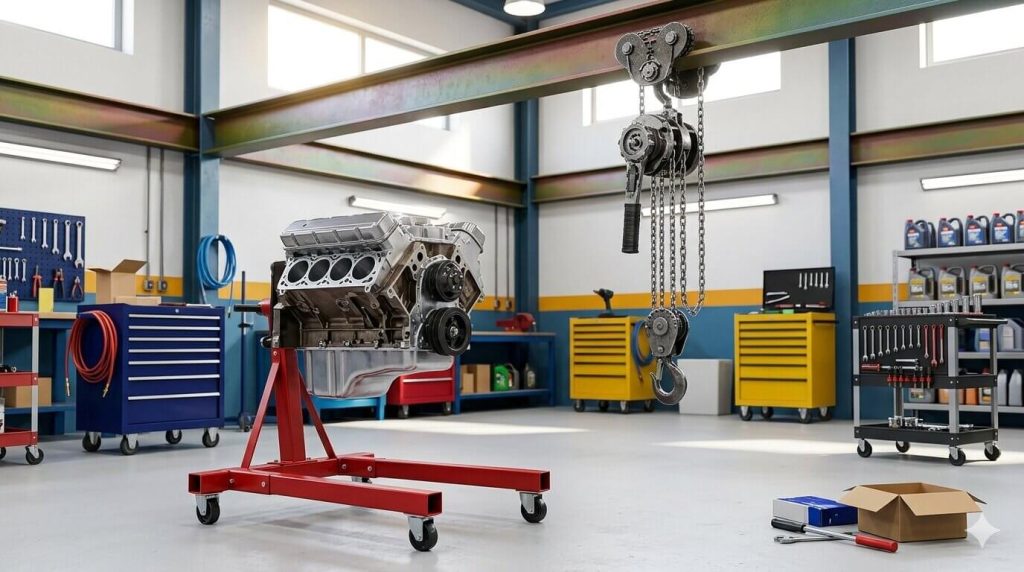
When the trusty hoist fails, you still have options. You do not have to give up and leave the car broken.
- Engine stand: People get this confused all the time. An engine stand is for holding the motor after it is out of the car. It lets you spin the heavy block safely to rebuild it. It does not lift the motor out.
- Overhead chain hoist: This is a lifesaver if you have zero floor space. It hangs high up from your roof. It pulls the motor straight up into the air. But be warned! Your garage roof beams must be extremely strong to handle the heavy weight.
- Professional service: Let us be totally honest. Sometimes, paying a real pro is the smartest choice. If you feel unsafe or lack the right space, call a local auto shop. There is zero shame in asking for help to avoid an injury.
Here is a simple look at your other options:
| Tool Choice | Best Time to Use It | The Biggest Drawback |
| Engine Hoist | Big garages with lots of flat floor space | Needs plenty of open room to roll around |
| Overhead Chain | Tiny, crowded garages with zero floor space | Needs a super strong, heavy-duty ceiling |
| Engine Stand | Rebuilding the motor after it is out | Cannot lift the motor out of the car itself |
| Local Auto Shop | When a job feels too dangerous to do alone | Costs more money than doing it yourself |
Knowing when to step back and change your plan makes you a much better mechanic. It saves your tools, saves your car, and keeps you safe.
Final Thoughts — Why Understanding How It Works Makes You Safer
It was late on a Sunday evening here in Dhaka. The hot sun was finally going down, casting long shadows across my driveway. I stood in my quiet garage, wiping thick, black grease off my hands with an old rag. The massive car motor was sitting safely on its stand. I actually laughed out loud. I remembered how terrified I was just a few hours before.
Once you really “get it,” the fear completely drops away. Total control takes over.
True confidence comes directly from understanding simple mechanics. When I first started, I thought the engine hoist was a dangerous metal beast. Now, I know it is just a simple mix of trapped fluid, long steel arms, and basic physics. When you know how the parts work together, the panic disappears.
You absolutely do not need brute human strength to do this job. I am certainly not a bodybuilder! All you need is patience and a very good setup. If you rush, you break things. If you take your time, double-check your heavy chains, and pump the handle smoothly, the job is incredibly easy.
The best advice I can share with my fellow beginners is this: let the hoist do the hard work. That is exactly why it exists. Do not fight it.
Here is a quick look at how your mindset changes once you learn the tool:
| How You Start the Job | What You Actually Do | How the Job Ends |
| Feeling scared or nervous | You learn the basic hydraulic physics | Fear drops and your safety goes up |
| Feeling weak or tired | You pump the easy metal handle | The hoist lifts the heavy weight for you |
| Feeling rushed or impatient | You stop, breathe, and check your setup | You get a smooth, safe, and easy engine pull |
The next time you stare down at a broken motor, take a deep breath. Roll your trusty engine hoist over. Trust the simple science, follow the safety rules, and enjoy the real satisfaction of fixing it yourself.
Frequently Asked Questions
Can I use this tool on a dirt floor?
No. You need a hard, flat floor to roll the hoist. A dirt path is very bad. The heavy tool can sink and tip over. Move your car to a flat garage space to stay safe.
Do I need two people to lift a car motor?
You can pump the tool alone. But a friend makes the job much safer. They can watch the heavy car motor and guide the long chain. Teamwork makes garage jobs fast.
How high can the boom arm reach?
Most shop cranes lift up to eight feet high. This gives you lots of room to pull a car engine. Just check your roof height first. You do not want to hit the top beams.
Will a small hoist lift a big truck block?
It depends on the weight limit. A normal shop crane lifts two tons. That is enough for big truck motors. Always read the safety tag on the metal frame before you start.
How do I store this tool when I am done?
Many great hoists fold up to save room. You pull out the metal pins and lift the legs up. It takes up much less space this way. Tuck it in a dry corner so it does not rust.