No, you cannot work under a car supported only by a floor jack, even for a minute, even for something quick. This is not caution for its own sake. A jack is built to raise a vehicle under active control, not to bear its weight unattended, and the failure modes that make this dangerous are documented, not hypothetical.
Direct answer: no, never, and here is why “just a minute” is exactly wrong
The rationalization behind working under a jacked car is almost always some version of “it’s only for a minute.” That framing is precisely backwards. A jack failure does not need minutes to become dangerous; it needs the moment you are underneath, however brief that moment is. There is no duration short enough to make an unsupported jack safe to be under, because the failure itself can happen at any point while the jack alone is holding the load.
What a jack is actually designed to do
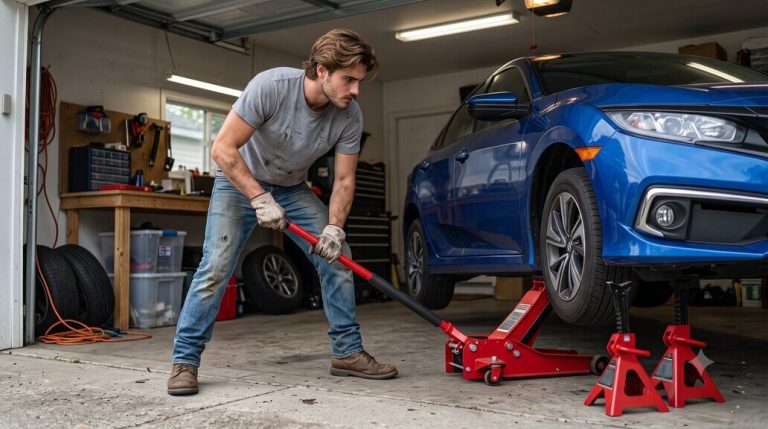
A hydraulic floor jack is engineered to raise a vehicle while you are actively operating the handle, under continuous control. That is its designed function, full stop. It is not designed, tested, or rated as a device to hold a static load indefinitely once you stop actively working it.
What a jack is not designed to do
A jack is not a support. Once you stop pumping the handle and the vehicle is at height, the jack’s hydraulic seal is what is keeping the load up, not a mechanical lock the way a jack stand’s pin or ratchet provides. That seal can hold for a while under normal conditions, but it is not engineered as a long-term or unattended support, and it is not designed to protect you if it fails while you are underneath.
The documented failure modes
This is not folklore. An NHTSA Research Note, built on data from the U.S. Consumer Product Safety Commission’s National Electronic Injury Surveillance System, estimated that roughly 4,822 people receive hospital emergency treatment annually in the United States for jack-related failure injuries. Of the incidents sampled in that data, about 74% were tied to the jack or the vehicle slipping or falling, and about 18% were tied to a loss of hydraulic pressure in the jack itself. Fatal incidents involving mechanics working under vehicles supported only by a jack have also been documented in occupational safety case reports. These numbers describe two real, recurring failure modes, not a single freak accident, and they are the reason the rule exists in the first place.
Why “it’s just for a second” is exactly the scenario these failures happen in
Both documented failure modes, slipping and pressure loss, can happen at any point while a load sits on a jack, including in the first few seconds. There is no version of “just a quick look underneath” that falls outside the window in which these failures occur. The rationalization assumes the danger scales with time spent underneath; the data says the danger is present the entire time the jack alone is holding the load, regardless of how long that turns out to be.
What to use instead, every time
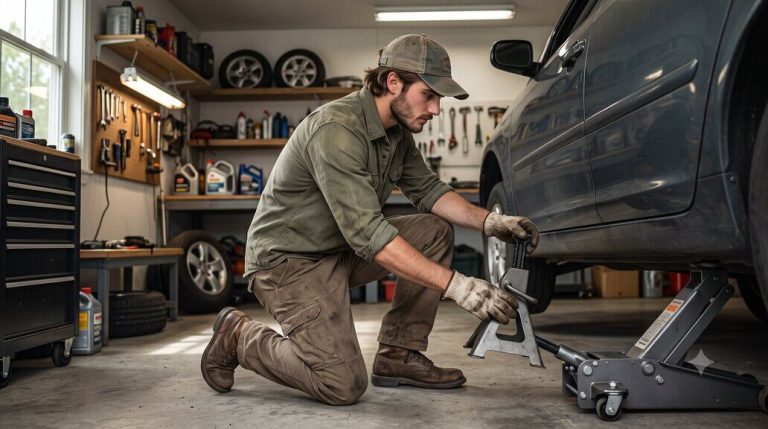
Once the vehicle is raised with the jack, place jack stands (or, for jobs that leave the wheels on, drive onto ramps) at the vehicle’s rated support points before anything, including any part of your body, goes underneath. Our comparison of jack stands vs ramps covers which is the right tool for your specific job, and our buying guide to jack stands covers what to check on a pair, including a real recall history worth knowing before you trust a used or older set.
A jack that “seems to hold fine” is not evidence
A common line of reasoning is that a particular jack has held a load for a while before without incident, so it must be trustworthy for a quick task. This reasoning mistakes the absence of a failure so far for evidence the failure mode does not apply. The documented causes above, slipping and pressure loss, are not present in every jack every time; they are the way a jack fails when it does fail, and a jack that has never failed for you yet has not been tested against that outcome, it has simply not encountered it yet. The rule holds regardless of how many times a given jack has “been fine” before.
How professional shops actually handle this
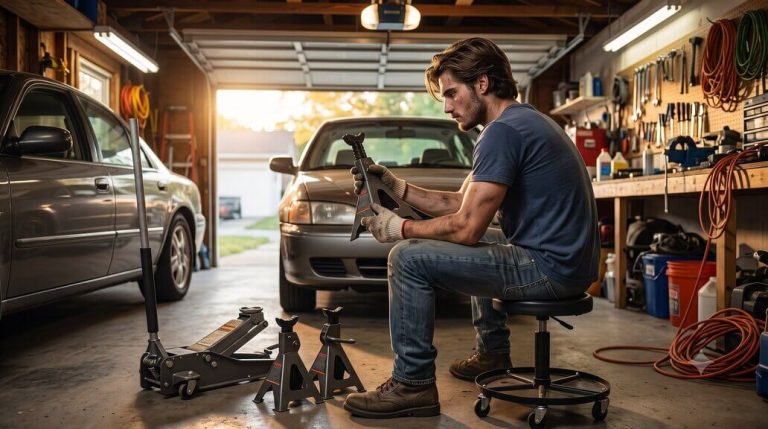
Professional shops almost universally use a jack to raise a vehicle and then immediately transfer the load to a fixed support, whether that is jack stands, wheel-clearing safety stands built into a lift, or a full two-post or four-post lift with its own mechanical locks, before anyone works underneath. The pattern is consistent across professional environments precisely because the same physics apply at any scale: a hydraulic jack raises, a separate mechanical device holds. A home garage following the same pattern, jack to raise and stands to hold, is following standard shop practice, not being overly cautious.
The full correct sequence, in one place
- Raise the vehicle with the jack, positioned at the correct factory jacking point.
- Place stands (or drive onto ramps) at the vehicle’s rated lift points.
- Lower the vehicle onto the stands gently and confirm they take the weight evenly.
- Test the setup with a firm push or shake before anything goes underneath.
- Only then, begin work. Our complete safe-lifting guide covers the ground conditions, wheel chocks, and jacking-point details that belong alongside this sequence.
What if you genuinely have no stands on hand yet
If you do not yet own jack stands and need to do a job that requires getting under the car, the honest answer is to wait until you have a proper pair rather than working around the gap with a jack alone or an improvised substitute like stacked wood or masonry blocks, which carry their own well-documented failure risk under a concentrated load. A pair of entry-level jack stands is inexpensive relative to the risk being managed, and our buying guide covers what a genuinely serviceable pair looks like without needing to spend heavily.
Frequently asked questions
Is it ever acceptable to reach briefly under a jacked-up car without stands?
No. The documented failure modes (slipping and hydraulic pressure loss) can occur at any point while a jack alone is holding the load, so there is no duration of exposure that is genuinely safe.
What actually causes a jack to fail while a car is raised?
Based on documented injury data, the two leading causes are the jack or vehicle slipping or falling, and a loss of hydraulic pressure in the jack itself.
Are expensive floor jacks exempt from this rule?
No. The rule is about what a jack is designed to do (raise, under active control) versus what it is not designed to do (hold indefinitely, unattended). Price and quality do not change that basic design purpose.
What should I use instead of a jack alone?
Jack stands placed at the vehicle’s rated support points, or ramps for jobs that don’t require a wheel off. Never the jack by itself.
How common are jack-related injuries, really?
An NHTSA Research Note using CPSC injury-surveillance data estimated roughly 4,822 annual hospital emergency visits in the U.S. tied to jack failures, which is a meaningful, ongoing number, not an isolated event.