Search this question and you will find genuine disagreement: some sites argue ramps are safer because of their wider contact area, others argue jack stands are the only real option once a wheel comes off. Both are right about their own case and neither is telling the whole story. The honest answer is that “safer” is the wrong question. The right question is which tool fits the job in front of you, and the two are not interchangeable.
Direct answer: the job decides, not a universal ranking
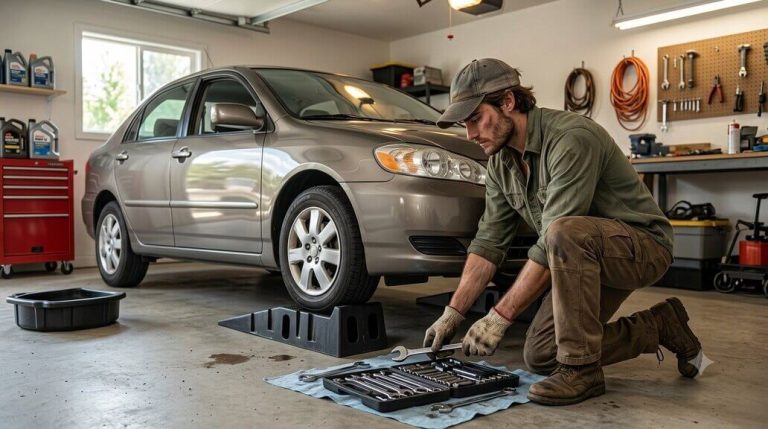
Ramps are well suited to jobs that leave the wheels on the ground, like an oil change, because you drive the car up and it rests on a wide, stable surface at both the ground and the tire. Jack stands are the only real option once a wheel comes off, since a ramp cannot support a car with a wheel removed at that corner. Neither is universally “the safer one”; each is safer for the job it is actually built for, and less safe when used for a job it was not built for.
Why some sources say ramps are safer
Ramps do have a real safety argument behind them: the vehicle rests on a wide ramp surface at the ground and the full tire contact patch at the top, which spreads the load and reduces tipping risk compared to a single point of contact. For straightforward jobs that don’t require a wheel off, like an oil change or an under-car inspection, that stability is real and ramps are a genuinely good, simple choice, especially for someone newer to working under their own car.
Why some sources say jack stands are safer
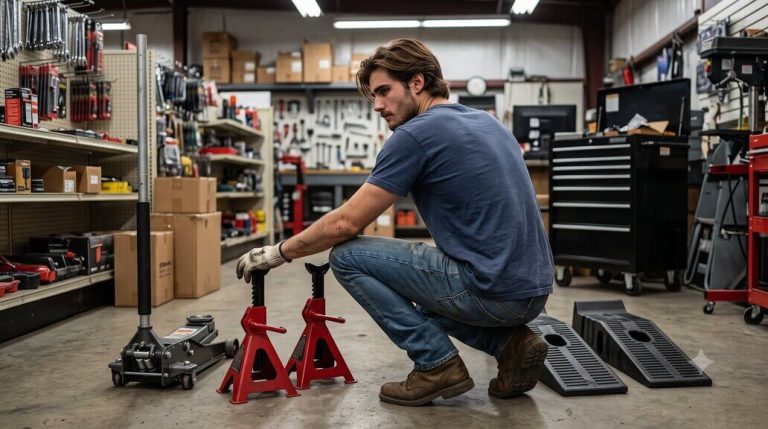
Jack stands win the argument the moment a wheel needs to come off, because a ramp offers nothing to support the car once that corner’s wheel is removed; there is no wide contact patch left to spread the load. For brake jobs, tire rotations, suspension work, or anything that requires a wheel off, jack stands (placed at the vehicle’s rated lift points, after raising with a jack) are the only correct tool, not a preference.

The risk ramps carry that “ramps are safer” articles tend to skip
Driving a car onto ramps by yourself, without someone spotting you, carries its own real risk: misalignment, a ramp that shifts as you approach it, or simply driving off the side edge. This is a genuine failure mode specific to ramps and it is worth taking seriously, especially the first few times you use a given set. A second person watching and guiding you on, or taking it slowly with frequent stops to check alignment, meaningfully reduces this risk.
The risk jack stands carry
A jack stand is only as good as the stand itself and the ground underneath it. A stand with a worn or improperly seated locking mechanism, or one placed on ground that is not flat and stable, can fail regardless of how correctly you use it in every other respect. Our buying guide to jack stands covers what to check before you trust a pair, including a real, sourced recall history worth knowing about if you already own a set.
A simple way to decide
Ask one question: is a wheel coming off for this job? If yes, jack stands are the answer, no substitute. If no, and the job is straightforward (an oil change, a visual inspection, a fluid check), ramps are a genuinely good, stable option and often the easier one for a beginner. Either way, a jack is never the thing that holds the car; see our full safety setup guide for the complete sequence, including the ground, the chocks, and the vehicle’s own jacking points.
Using both together
Some jobs genuinely use both: driving the front onto ramps for one task while a rear corner is jacked and stood separately for another. This is a real, common practice, and it does not relax any of the underlying rules; each end of the car still needs its own correct support, tested independently, and a jack still never substitutes for a stand at the end that is jacked.
What to check before buying either one
Whichever tool fits your job, the same underlying question applies before you buy: does the rated capacity comfortably exceed your vehicle’s actual weight, and does the tool carry a visible standards marking rather than an unlabeled generic listing. For ramps, also check the tread surface for grip and confirm the rated capacity accounts for the weight actually resting on one ramp, not the vehicle’s total curb weight divided evenly, since most vehicles do not sit perfectly balanced front to rear. For stands, our buying guide covers the ratchet-versus-pin decision and a real recall history worth checking if you already own an older steel pair.
Storage and everyday practicality
Beyond the safety question, the two differ in how they fit into daily use. Ramps are generally bulkier to store, being long, sloped pieces that don’t stack or tuck away as compactly as a pair of stands, though some folding designs exist specifically to address this. Jack stands store more compactly but require you to jack the car and place them correctly every single time, which takes a bit longer than driving up a ramp. Neither difference should override the actual safety question above, which is which tool suits the job, but it is a real, honest factor in which one you reach for on a given weekend.
A word on cost
Entry-level ramps and entry-level jack stand pairs are both inexpensive relative to most other garage tooling, and price alone should not be the deciding factor between them, since they are not substitutes for each other in the first place. Spending more on either generally buys a higher rated capacity, a more durable tread or locking mechanism, and in some cases a lower-profile ramp design for tighter-clearance vehicles, rather than a fundamentally different safety proposition.
Frequently asked questions
Is it ever true that one is just universally safer than the other?
No. Each is safer for the specific job it is designed for. Ramps suit jobs that keep the wheels on the ground; jack stands are the only option once a wheel comes off. Comparing them outside the context of a specific job does not produce a meaningful answer.
Can I use ramps for a tire rotation?
No. A tire rotation requires the wheel off, and ramps offer no support once that happens. Use a jack to raise the car and jack stands to hold it.
Are ramps safer for someone new to working on their own car?
For jobs that don’t require a wheel off, many people find ramps more straightforward, since there is no jacking or stand placement involved. Take it slowly and, if possible, have someone spot you the first few times.
What’s the biggest mistake people make with ramps?
Driving up alone without a spotter, especially the first few times with a given set of ramps, which raises the risk of misalignment or driving off the edge.
Do jack stands need to be checked before every use?
Yes. Confirm the locking mechanism seats fully and the stand sits on flat, stable ground every time, regardless of how many times you have used that pair before.