A floor jack that shows up and doesn’t fit under your car is one of the most common, and most avoidable, buying mistakes in a home garage. Vehicle forums across nearly every make and model repeat the same story: a jack ordered on rated capacity alone, then returned because it physically could not reach the jacking point or could not lift high enough to get a stand underneath. Three measurements, taken before you buy, avoid this entirely.
Direct answer: measure minimum clearance, required lift, and add margin
Before buying any floor jack, take three measurements against your own vehicle: the clearance at your actual jacking point, how high you need to lift to get a jack stand underneath, and a margin on top of both to account for suspension droop as the wheel comes off the ground. Skip any one of these and you are relying on luck rather than fit.
Measurement 1: clearance at your actual jacking point
Measure from the ground to your vehicle’s specific factory jacking point, found in your owner’s manual, not to the lowest body panel or rocker sill, which usually sits lower than the actual reinforced lifting point. This number tells you the maximum minimum-saddle-height a jack can have and still slide into position. Most standard jacks start around 3.5 to 4 inches at their lowest setting; if your measured clearance is tighter than that, you need a low-profile jack instead of a standard one.
Measurement 2: how high you actually need to lift
Decide what the job requires. If you are getting a wheel off, you need enough lift height to get a jack stand positioned and locked underneath the vehicle’s rated support point, with the wheel clear of the ground. A typical 3-ton floor jack lifts to somewhere around 18 to 20 inches, which covers most passenger cars, SUVs, and trucks with stock suspension; trucks with taller frame rails may need more than 20 inches, so check the jack’s stated maximum against your specific vehicle rather than assuming a standard jack covers every case.
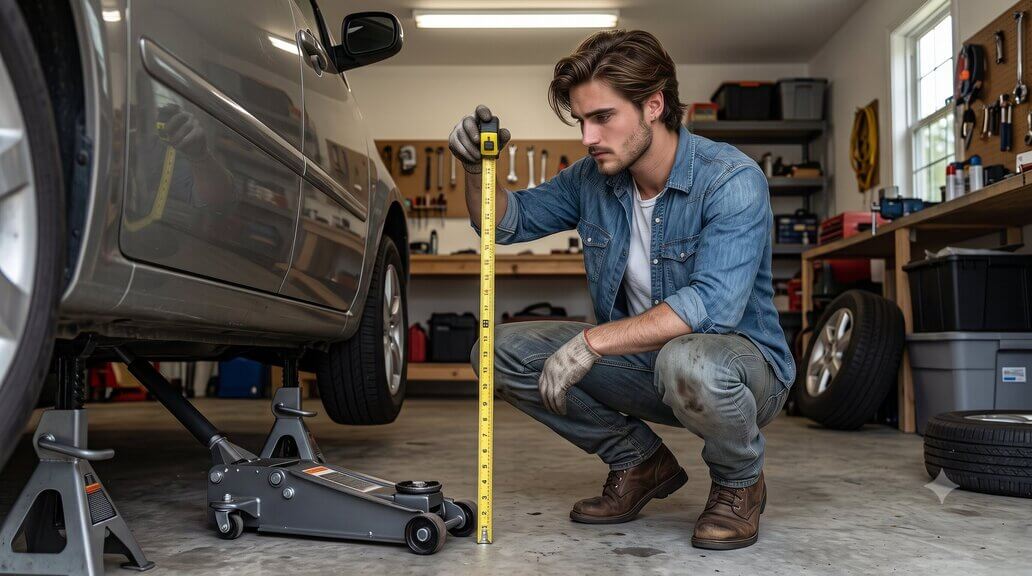
Measurement 3: the margin rule, and why suspension droop matters
Once you know your clearance and required lift, add roughly five inches of margin on top of the floor-to-jacking-point measurement as a rule of thumb, because the wheel will droop further on its suspension as weight comes off it during the lift, changing the geometry from where it started. This margin is what separates a jack that technically clears your car sitting still from one that actually gets the job done once the suspension has extended.
What happens if you get it wrong in either direction
Too little minimum clearance and the jack simply will not slide into position at your jacking point; you will find this out the moment you try to use it, not before. Too little maximum lift and you can raise the car partway but cannot get a jack stand fully seated and locked underneath, leaving you stuck mid-job with a car you cannot safely support. Neither mistake is a matter of technique; both come from skipping the measurement stage before buying.
When the answer is a low-profile jack instead
If your measured clearance at the jacking point comes in tight, especially under roughly 3.5 inches, a standard jack is not going to fit regardless of brand or price point, and a low-profile jack is the correct category to shop in instead. Our piece on who genuinely needs a low-profile jack walks through that decision in full, and our aluminum vs steel comparison covers the separate material decision once you know which category fits your car. Whichever jack you land on, it is only ever the tool that raises the car; our complete safe-lifting guide covers what has to happen next.
How to actually take these measurements at home
You need a tape measure and your owner’s manual, nothing specialized. With the vehicle parked on flat ground in its normal resting position, locate the factory jacking point closest to you and measure straight down to the ground. Repeat at a second jacking point if your vehicle’s front and rear clearance differ noticeably, which is common on trucks and some sedans with a rake to their stance. Write both numbers down before you start comparing jacks, rather than trying to hold them in your head while reading spec sheets.

Why this affects some vehicles more than others
Owner forums for trucks, lowered sedans, and some SUVs repeat this problem specifically because those vehicle categories sit at the two extremes: trucks often need more maximum lift height than a standard jack provides at their taller frame rails, while lowered sedans and sports cars often need less minimum clearance than a standard jack’s lowest setting allows. A mid-size sedan or crossover with stock suspension is far less likely to run into either extreme, which is part of why the problem shows up so consistently in forums for specific vehicle types rather than as a universal complaint.
Don’t rely on the box alone
Retail packaging and online listings usually state a jack’s minimum height, maximum lift, and rated capacity, but the exact wording and where each figure sits on the page varies a great deal between brands and retailers. Read all three figures directly, ideally from the manufacturer’s own specification page rather than a marketplace listing’s summary, and compare them against your own two measurements before buying, rather than trusting a “fits most cars” claim in the listing copy.
Keep the numbers with your other garage notes
Once you have measured your vehicle’s clearance and required lift height, keep those two numbers somewhere you will actually find them again, alongside any other garage notes you keep for that vehicle. Vehicles are occasionally swapped or added to a household, and having the measurement already done saves you from re-measuring from scratch, or worse, buying by rated capacity alone again and running into the same fit problem a second time.

Frequently asked questions
How do I find my vehicle’s factory jacking points?
Check your owner’s manual, which will show the specific reinforced points on the frame or unibody designed to carry the vehicle’s weight during a lift. Don’t guess based on what looks solid from underneath.
What’s a safe rule of thumb for lift height margin?
A commonly cited approach is to add roughly five inches to your floor-to-jacking-point measurement, to account for the wheel drooping further on its suspension as weight comes off during the lift.
My truck has tall frame rails. Will a standard jack reach high enough?
Not always. Trucks with taller frames sometimes need more than the 18 to 20 inches a typical 3-ton jack provides. Check the jack’s stated maximum lift height against your specific vehicle before buying.
Can I just buy the jack with the highest rated capacity to be safe?
Rated capacity (the weight it can lift) is a separate spec from minimum clearance and maximum lift height. A jack can have plenty of capacity and still not physically fit your car if the height specs are wrong for your vehicle.
What if my car doesn’t fit under any standard jack?
That is the specific situation a low-profile jack is built to solve. Measure your clearance first, then shop in the low-profile category if a standard jack’s minimum height is too tall to clear your jacking point.