Once the engine is out of the vehicle, a stand is what holds it while you actually work on it, and the choice between rotating and fixed comes down to what that work involves. If you are tearing down, rebuilding, or doing work that requires access to the top, bottom, and sides of the engine, a rotating stand earns its cost by letting you turn the engine without unbolting it from the mount. If you are simply holding the engine steady for a straightforward job like a clutch or accessory swap, a fixed stand is genuinely enough.
What rotating actually buys you, and friction vs geared rotation
A rotating stand’s mounting head turns, letting you flip the engine to reach the oil pan, then bring it back upright for top-end work, all without disconnecting it from the mount. For anything beyond a quick, single-side job, that saves real time and reduces how often you are wrestling the engine’s position by hand.
Rotation mechanisms generally come in two types. Friction rotation is simpler and cheaper, using resistance against the mounting arm to hold position, but it can slip under a heavy or unevenly balanced load if the friction setting is not adequate for the engine’s weight. Geared rotation uses a gear mechanism to hold position positively and turn with more control, which tends to feel more secure under load, particularly with heavier engines. If you expect to rotate the engine frequently or under real weight, geared rotation is the more dependable choice; for occasional, lighter use, friction rotation can be adequate.
What “rated capacity” really means on an engine stand
As with an engine hoist, the number printed on an engine stand is a rated maximum, not a target to approach. It is measured under the manufacturer’s own test conditions and is specific to that stand’s mounting head, arm, and base. It is not a number you should compare loosely across brands or assume applies the same way to a different stand.
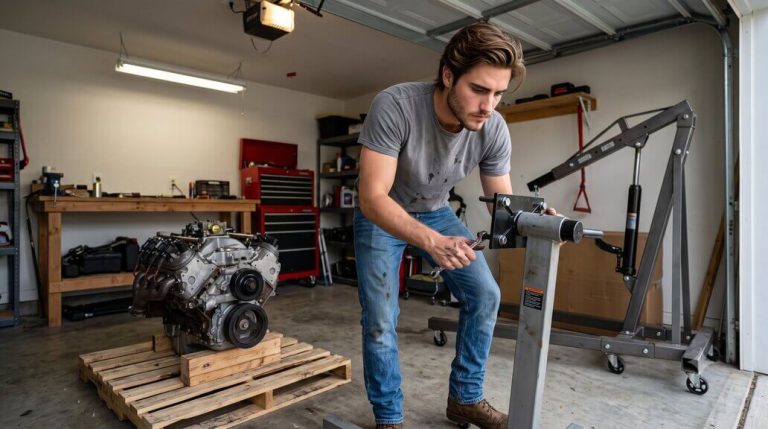
Before mounting an engine, confirm your stand’s actual rated capacity from its own plate or documentation, and compare it honestly against your engine’s real dressed weight, with accessories, and with the transmission if it will be mounted as well. Leave meaningful margin between your engine’s actual weight and the stand’s rated limit; do not mount at or near the stated maximum. Our guide on engine hoist lift capacity covers how to estimate an engine’s real weight before it ever reaches the stand.
Casters and the locking mechanism: what actually matters
A stand with more caster contact points and lockable wheels is generally more stable when you need to reposition a mounted engine around the garage, and locking casters keep the stand from rolling away mid-job. Beyond wheels, the rotation locking mechanism itself matters: look for a stand that lets you positively lock the engine at a given angle rather than relying on friction alone to hold position while you work with both hands elsewhere. The specifics of how frequently a given stand locks, and at what intervals, vary by model. Check the manufacturer’s own specification rather than assuming a generic interval applies.
The same caster-quality reasoning that applies to engine hoists applies here: a stand that will not roll smoothly under a mounted engine’s weight is a hazard, not just an inconvenience. See our piece on engine hoist casters for the underlying reasoning, even though it is written about hoists specifically.
The part that fails in practice: mounting plate and bolt pattern compatibility
Generalist buying guides spend most of their attention on rated capacity and rotation type. In practice, the more common real-world problem reported by home mechanics is a mounting bracket or bolt pattern that does not properly match the engine’s bellhousing or block, or hardware that was not torqued correctly during mounting. An engine improperly secured to the stand’s mounting plate can shift or come loose regardless of how much rated capacity the stand has in reserve.
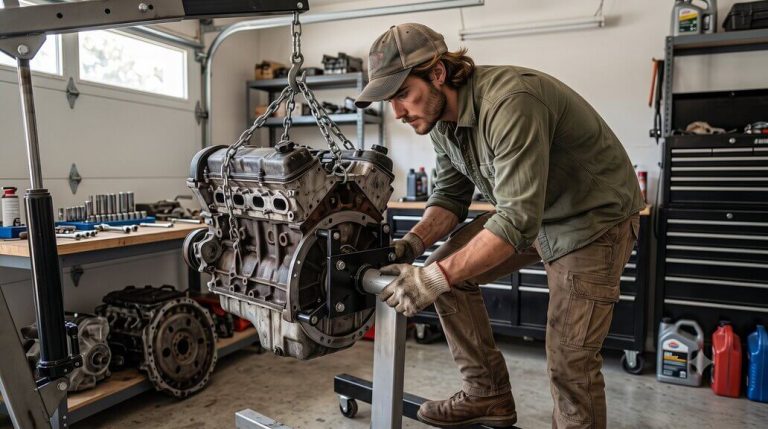
Before you mount an engine, confirm the stand’s mounting plate and adapter kit is actually compatible with your specific engine’s bellhousing pattern, and torque the mounting hardware to the fastener manufacturer’s specification, not by feel. This is the step most likely to go wrong and the one least discussed in typical buying content. If your rigging involves a lift plate or chain to move the engine onto the stand in the first place, see our comparison of lifting plates, chains, and load levelers.
Storing a stand between projects
An engine stand does not fold the way a hoist does, but it still takes up real floor space whether or not it currently has an engine mounted. If your garage does double duty as a car space, plan for where an empty stand lives between projects, the same way you would plan storage for a hoist. Our comparison of folding vs fixed hoists covers this trade-off in more depth for the hoist itself, and the same space-planning logic applies to a stand sitting empty for months between rebuilds.
When a fixed stand is genuinely the right choice
A fixed stand is a reasonable, honest choice when your work does not require repositioning the engine: holding it steady for an accessory swap, a clutch job on an engine already largely assembled, or any task where you are working primarily from one side. Paying for rotation you will not use is not a better safety decision, just a more expensive one for no real benefit.
Buying checklist
- Decide honestly whether your work needs full rotation or just steady holding.
- If rotating, choose geared rotation for frequent or heavy use; friction can suit occasional, lighter use.
- Confirm the stand’s rated capacity against your engine’s actual dressed weight, with real margin, from the stand’s own documentation.
- Confirm the mounting plate and adapter kit are compatible with your specific engine’s bellhousing pattern before mounting.
- Torque mounting hardware to the fastener manufacturer’s specification, not by feel.
- Check caster quality and locking mechanism for stability while repositioning a mounted engine.
Frequently asked questions
Is a rotating engine stand worth the extra cost for occasional home use?
It depends on the work. If you are doing a full teardown or rebuild that requires accessing the engine from multiple angles repeatedly, rotation saves real time and effort. For a single, one-sided job, a fixed stand is genuinely enough.
What’s the difference between friction and geared rotation?
Friction rotation holds position through resistance against the mounting arm and is simpler and cheaper, but can slip under heavier or unevenly balanced loads. Geared rotation holds position positively through a gear mechanism and generally feels more secure under weight, especially with heavier engines.
How do I know my engine stand’s rated capacity is enough?
Check the stand’s own rating plate or manufacturer documentation, then compare it against your engine’s actual dressed weight, including accessories and the transmission if mounted, with meaningful margin. Never mount at or near the stated maximum.
What actually goes wrong with engine stands in practice?
Reported problems are more often about mounting-plate incompatibility or improperly torqued mounting hardware than about exceeding rated capacity. Confirming your stand’s adapter kit matches your engine’s bellhousing pattern is worth as much attention as checking the capacity rating.
Do I need locking casters on an engine stand?
They are worth having if you expect to reposition a mounted engine around the garage. A stand that rolls unexpectedly while an engine is mounted is a real hazard, not just an inconvenience.