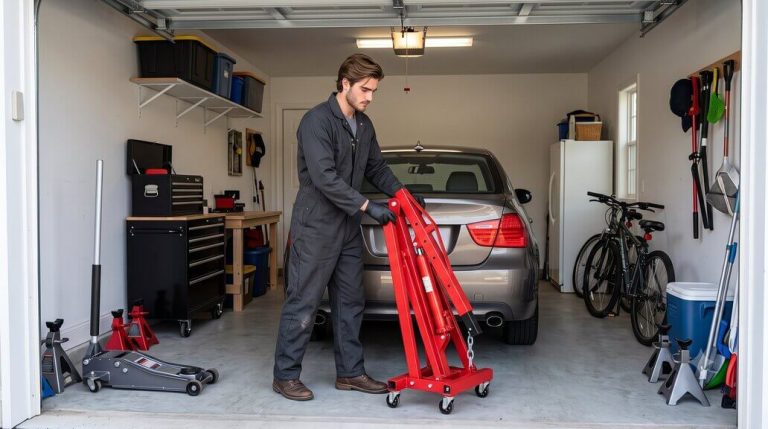
For almost every one-car garage, a folding engine hoist is the right call. The legs and boom collapse down so the hoist stores against a wall or in a corner between jobs, which matters when a car needs to fit in the same space the rest of the time. The exception is a garage dedicated entirely to engine work with no car sharing the floor, where a fixed frame’s small stability edge is worth the permanent floor space it takes up.
Note on scope: this article covers the hoist’s own folding mechanism and storage footprint only. General garage shelving, workbenches, and workshop layout are a separate subject on this site (see our garage-setup coverage), and if your interest is workshop storage for tools generally rather than one piece of lifting equipment, that is a different lane entirely.
Why folding wins on storage, and what “footprint” actually means
The obvious appeal of a folding hoist is that it does not have to live in the middle of your garage year-round. Collapsed, the boom folds down toward the legs and the whole unit can be walked or rolled into a corner, against a wall, or behind a car. For a one-car garage, that is frequently the difference between a hoist you can actually own and one you have nowhere to put.
The mistake buyers make is assuming “folds up” automatically means “small enough for my space.” It does not. Folded footprint varies by model, and a hoist that collapses well still occupies real floor or wall space when stored. Before buying, measure the corner or wall space you actually have available and compare it against the folded dimensions listed for the specific hoist you are considering, not against a general assumption that “folding ones are compact.” Our post on how much an engine hoist weighs covers the related question of how much the unit weighs to move and store, which matters just as much if you are working alone.
The honest rigidity trade-off, and why it rarely matters for occasional use
Here is the trade-off generalist buying guides state as a flat fact without explaining: a folding hoist has more pivot points and pins than a fixed frame, because the joints that let it collapse are the same joints that carry the load when it is deployed. More pivot points mean more places where play or wear can accumulate over years of use, and that can translate to a marginally less rigid feel under a heavy, swinging load compared to a one-piece fixed frame.
For most home use, this difference does not matter in practice. If you pull an engine once or twice a year and store the hoist the rest of the time, a well-built folding hoist used within its rated capacity is not meaningfully less safe than a fixed one. The rigidity gap becomes more relevant if you use the hoist frequently, under heavy loads, at longer boom positions, where any looseness in the joints has more leverage to act on. If that describes your use case more than “one project a year,” that is the actual argument for a fixed frame, not storage convenience.
When a fixed frame is worth the floor space
A fixed-leg hoist is worth choosing over a folding one in a narrow set of situations: a dedicated engine bay or shop space where the hoist never has to move for a car to park, frequent heavy lifts where the extra rigidity has more chances to matter, or a hoist that will see years of regular commercial-adjacent use rather than occasional home projects. Outside of those cases, the storage advantage of folding usually outweighs the small stability edge of fixed.
If you are unsure which category you fall into, our buying guide walks through the full set of criteria (capacity headroom, boom reach, build quality) that matter regardless of which frame style you choose.
What actually determines how a folding hoist feels in use
Folding versus fixed is not the only, or even the biggest, factor in how stable a hoist feels once it is loaded and moving. Leg spread, weld quality, and, often overlooked, the caster wheels do more to determine whether a hoist feels planted or unsteady than whether its frame folds. A folding hoist with a wide, well-built leg base and solid casters will typically feel more stable in real use than a fixed hoist with a narrow stance and weak wheels. See our piece on engine hoist casters for the detail that buyers notice last and regret first.
If your job is genuinely a one-time pull rather than an ongoing need for either frame style, it is also worth asking whether buying any hoist makes sense at all. Our honest breakdown of renting vs. buying an engine hoist covers that math directly.
Hardware wear from repeated folding: what to check
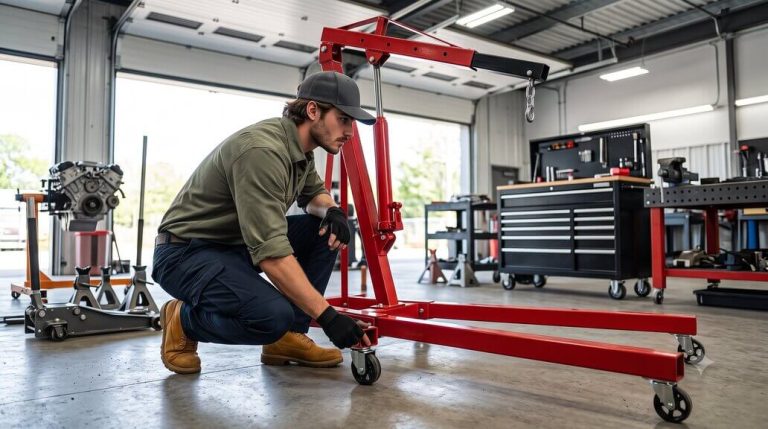
One detail almost no buying guide mentions: a folding hoist’s pivot pins and joints see cyclic stress every single time you fold and unfold it, not just when it is loaded. Over years of regular folding, those pins and the holes they pass through can develop play, which is a separate wear pattern from the load-bearing wear a fixed frame experiences only while lifting.
This is a maintenance item, not a reason to avoid folding hoists. Check pivot pins and locking mechanisms periodically for looseness, replace worn pins rather than continuing to use a joint that has developed play, and never fold or unfold a hoist while it has any load on the boom. A hoist that has folded smoothly for years can still develop enough wear to need attention, so treat this as a standing item on the same maintenance schedule you would use for casters or the hydraulic ram.
Buying checklist
- Measure the corner, wall, or storage space you actually have before comparing folded footprints.
- Confirm the folded dimensions of the specific model you are considering, not a general assumption.
- Be honest about frequency of use: occasional favors folding, frequent-and-heavy favors fixed.
- Check leg spread and caster quality regardless of frame style; these affect stability as much as folding does.
- Confirm rated capacity at the boom position your jobs require, independent of frame style.
Frequently asked questions
Is a folding engine hoist as safe as a fixed one?
Used within its rated capacity, yes, for the occasional home use most garage owners actually do. Folding hoists have more pivot points, which can mean marginally less rigidity under frequent heavy use, but that difference is not a safety failure at normal home-garage frequency.
How much floor space does a folded engine hoist actually need?
It varies by model. Measure the specific hoist’s listed folded dimensions against your available corner or wall space rather than assuming all folding hoists are similarly compact.
Do fixed-frame hoists lift more weight than folding ones?
Not inherently. Rated capacity depends on the specific hoist’s build, ram, and boom, not on whether the frame folds. Compare rated capacity at your required boom position separately from the folding decision.
Should a dedicated engine-work garage still choose folding?
Not necessarily. If the hoist never has to make room for a parked car and you lift frequently, the small rigidity advantage of a fixed frame can be worth the permanent floor space.
What should I measure before buying a folding hoist?
The exact storage space you intend to use (corner, wall run, or behind a parked car), compared against the specific model’s published folded dimensions, not a general expectation of how compact “folding” means.