Every engine hoist has a chart, usually a stamped plate or a decal on the boom itself, that lists the hoist’s safe rated capacity at each boom position. The number on the box is only true at the shortest position. As the boom extends, the safe capacity drops, and how much it drops is different for every hoist, so the only number that matters for your lift is the one printed on your own hoist’s plate, at the position you are actually going to use. Nobody should ever estimate this from a general example, including anything in this article.
Why capacity falls as the boom extends
The mechanics are the same on every hoist, even though the exact numbers differ. The hydraulic ram that does the lifting has a fixed amount of force it can safely generate. As the boom telescopes outward, the load hangs farther from the pivot point where the ram acts, on a longer lever arm. A longer lever arm needs more force to hold the same weight, so with the ram’s force fixed, the weight it can safely hold goes down as the reach goes up.
This is why “how far do I need to reach” is as important a question as “how heavy is my engine.” Two identical-looking hoists from different manufacturers can lose capacity at very different rates as the boom extends, because boom length, ram size, and pivot geometry all vary. That is exactly why this article does not include a sample chart: any illustrative numbers would invite you to compare them to your own hoist, and they would very likely be wrong for it.
More boom positions is not automatically better
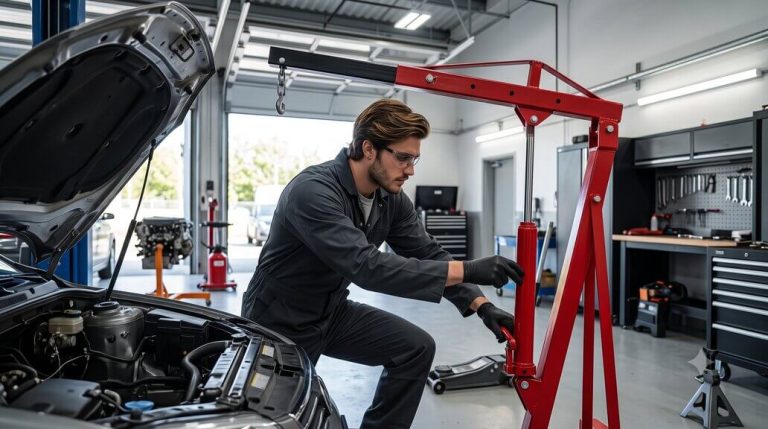
Some hoists offer more stops along the boom than others, which sounds like more flexibility. In practice, more positions mean finer control over the trade-off between reach and capacity, not a way around the trade-off itself. A hoist with four stamped positions still only guarantees the rated capacity at those four points, nowhere in between.
What actually matters when comparing hoists is not the number of positions but whether the position you will realistically need for your engine bay still leaves you comfortable capacity margin. Our buying guide and our comparison of 1-ton vs 2-ton hoists both come back to this same point: buy for the boom position your job requires, not for the shortest one.
How to read your specific hoist’s chart correctly
Three habits separate people who use the chart correctly from people who do not, and all three come up repeatedly in owner forum discussions of engine hoist use:
- Find the plate before your first lift, not during it. It is usually on the boom itself, sometimes inside the owner’s manual only. If you cannot locate it, contact the manufacturer before you lift anything on that hoist.
- Measure your actual position, do not eyeball it. The chart is keyed to specific stamped positions or pin holes, not to “about halfway out.” Confirm which position pin or stop you are actually using before you commit to a lift.
- Never interpolate between two stamped positions. If your reach falls between position 2 and position 3 on the chart, the safe assumption is the capacity for the longer, lower-rated position, not an average of the two. The chart tells you what has been rated and tested; anything between two points has not been.
What happens when the chart gets ignored
The failure mode is not subtle. A hoist loaded beyond its rated capacity at a given boom position can fail at the ram, the boom, or the mounting pins, and when it does, the load drops with no warning. This is the same underlying mechanism behind every documented hoist-related lifting injury in general workplace safety literature (OSHA’s material-handling equipment guidance treats exceeding a rated lift capacity as a primary cause of dropped-load incidents), and it applies just as directly in a home garage as in a commercial shop. There is no boom position at which this rule relaxes.
This is also why “the boom looked fine at that reach last time” is not a safety standard. Rated capacity is a limit the manufacturer tested to, not a suggestion you can judge by feel. Our full safety checklist covers the rest of what a safe lift requires beyond capacity alone, including never standing under a suspended load.
How this connects to the 1-ton vs 2-ton decision
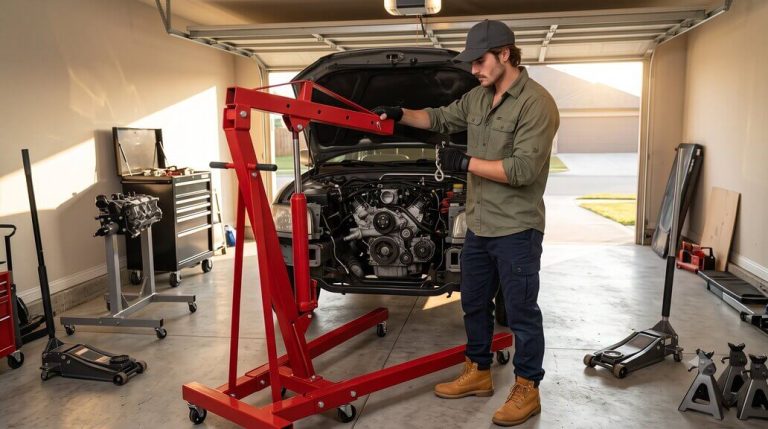
If you are still deciding what hoist to buy, the boom chart is the reason tonnage alone is the wrong shopping question. A “2-ton” hoist only means 4,000 pounds at its shortest position. What you actually need to know before buying is whether that hoist’s capacity at the boom position your garage and vehicles will require still comfortably clears your heaviest job. Our 1-ton vs 2-ton comparison walks through exactly this trade-off. If your lift also involves tilting the engine to clear obstructions, the leveler, chain, or lifting plate you attach matters too. See our breakdown of load levelers, chains, and lifting plates.
Pre-lift checklist
- Locate your hoist’s boom-position chart before you touch the pump handle.
- Identify which stamped position you will actually use for this vehicle and engine bay.
- Confirm the rated capacity at that exact position, not an estimate or a number from any other hoist.
- Confirm your engine’s real weight, with accessories and transmission if attached, is comfortably under that rated figure.
- If your required reach falls between two stamped positions, treat the longer position’s lower rating as the limit.
- If you are unsure of any of the above, stop and contact the manufacturer or a qualified professional before lifting.
Frequently asked questions
Where do I find my engine hoist’s boom capacity chart?
Check the boom itself for a stamped plate or decal first; if it is not there, check the owner’s manual. If you cannot locate either, contact the manufacturer directly before using the hoist for a heavy lift.
Does every engine hoist lose capacity at the same rate as the boom extends?
No. The rate of loss depends on the specific hoist’s boom length, ram size, and geometry, and it varies meaningfully between models and manufacturers. This is exactly why no general chart or example number can substitute for your hoist’s own rating plate.
Can I estimate my capacity if my reach falls between two stamped positions?
No. Use the rated capacity for the longer, lower-capacity position of the two. The chart only certifies the stamped positions; anything between them has not been tested to a known rating.
Is a hoist with more boom positions safer?
Not inherently. More positions give you finer control over the reach-versus-capacity trade-off, but the hoist is still only rated at its stamped positions, and the underlying physics (capacity falling as reach increases) applies regardless of how many stops the boom offers.
What should I do if I can’t find a rating for the exact position I need?
Stop and use a shorter boom position with a confirmed rating, reposition the vehicle or hoist so a rated position works, or contact the manufacturer. Never lift at an unrated or estimated position.