To use an engine hoist safely, do three things before you ever pump the handle: match the engine’s weight to your hoist’s rated capacity at the boom length you actually need (not the number stamped on the box), rig the engine to its proper factory lift points with rated lifting chains and hardware, and never put any part of your body under a suspended load. A dropped engine weighs several hundred pounds and does not care how careful you felt a second earlier. Work on level ground, lift slowly, keep the load low, and never leave an engine hanging.
That is the short version. The rest of this checklist walks each stage in order, with the one detail most step-by-step guides skip: your hoist’s rated capacity is not a fixed number.
The capacity check that most guides skip: rating drops as the boom extends
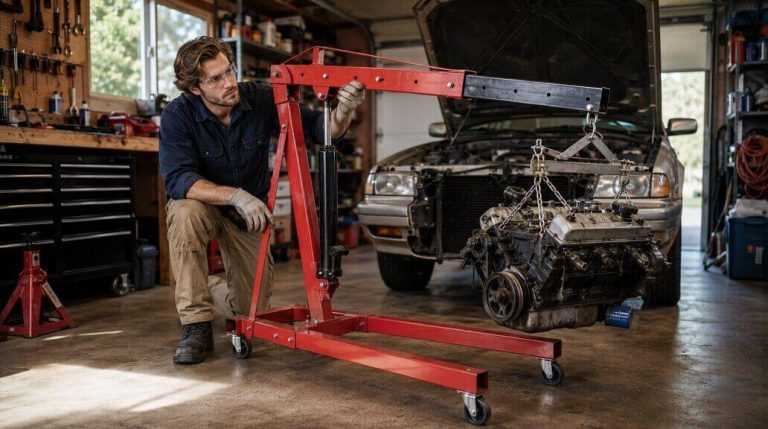
Here is the fact that belongs at the top of every engine hoist safety article and almost never is. An engine hoist’s rated capacity is measured with the boom fully retracted. The moment you extend the boom to reach into an engine bay, the safe capacity drops, often steeply.
A hoist sold as a “2-ton” crane may be rated for only about half a ton at its furthest reach. That is not a defect. It is basic leverage: the further the load sits from the hoist’s front legs, the more it tries to tip the crane forward, so the safe load falls at every extension step.
This is why every engine hoist has a load chart printed on the boom itself, usually as a series of numbers next to the extension holes (for example, a rating at position 1, a lower one at position 2, and so on). Before you lift, do this:
- Find your engine’s actual weight. Look it up by engine family, not by guessing. A small four-cylinder is very different from a big cast-iron V8.
- Decide the boom position you will need to reach the lift point. Longer reach, lower rating.
- Read the rated capacity for that position on the boom’s load chart.
- Confirm the engine weight is comfortably under it. A common rigging habit is to leave a margin, roughly 25 percent of headroom, so the load sits well below the rated limit rather than right at it.
If the engine weight is close to or above the chart figure at the reach you need, stop. Do not “just try it.” Retract the boom, reposition the vehicle so you need less reach, or use a higher-capacity hoist. We cover picking the right tool for the job in our guide to the best engine hoist for a home garage, and how a hoist stacks up against fixed lifting gear in engine hoist vs shop crane vs gantry crane. For the underlying numbers, our post on engine hoist lift capacity breaks down what the rating actually means.
Step 1: Prep the space and the vehicle
The lift is only as stable as the floor under it.
- Level, solid ground. A concrete garage floor or equally firm, flat surface. Not gravel, not grass, not a slope. The casters need to roll freely and predictably, and the crane must not want to drift.
- Chock the wheels and set the parking brake so the vehicle cannot move while you work over it.
- Clear the path you will roll the engine along. Move creepers, cords, tools, and anything you could trip on while guiding a swinging load.
- Check overhead clearance. Booms lift higher than people expect. Confirm nothing above (a shelf, a garage door track, a light) is in the arc.
- Good lighting, and eye protection on. Fluids and debris come loose during a pull.
Understanding how the tool converts a small hand effort into a large lift helps you respect it; our explainer on how an engine hoist works covers the hydraulic ram and boom leverage in plain terms.
Step 2: Fully disconnect the engine
The hoist should never take load against something still bolted to the car. This is a checklist, not a full engine-removal manual, but the principle is absolute: the only things holding the engine when you start to lift should be the engine mounts you plan to unbolt, nothing else.
Before rigging, confirm you have disconnected or removed, as your job requires: fuel and coolant lines (with fluids drained and caught), the wiring harness and grounds, throttle and shift linkages, exhaust connections, the transmission or bellhousing bolts if the engine is coming out alone, and any brackets tying the engine to the body. Cap open lines. Label connectors as you go.
A single forgotten wire or hose can snap under lifting force or, worse, hold the engine at an angle that shock-loads the rig.
Step 3: Rig to the proper lift points with rated hardware
How the engine hangs is where safety is won or lost.
- Use rated lifting chains, slings, and hardware. Every chain, hook, ring, and load leveler carries a working load limit. OSHA’s rigging standards require that alloy steel chain slings are never loaded beyond the rated capacity shown on their permanent identification tag, and that hooks and links used with them are rated at least as high as the chain itself. Do not lift an engine on hardware store chain of unknown rating, tow straps, or rope.
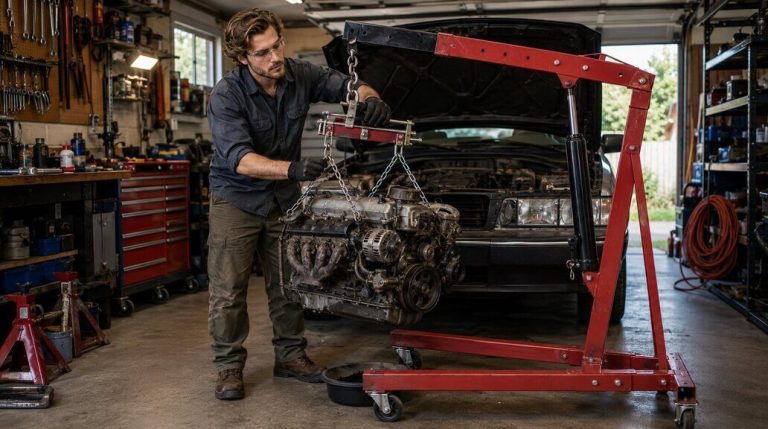
- Attach to designed lift points. Most engines have factory lifting eyes or brackets, or documented bolt bosses meant for lifting. Use them. Bolting a lifting plate to intake or accessory bolts that were never meant to hold the whole engine can strip threads mid-lift.
- Use a load leveler. This is the geared bar between the hook and the chains that lets you tilt the engine as you lift. It gives you control to clear the firewall and match angles instead of fighting a fixed, swinging load.
- Inspect before you lift. OSHA requires slings and their fastenings to be inspected for damage before use, and shock loading is prohibited. Look for stretched links, cracked hooks, cuts, or a bent leveler. Anything questionable comes out of service.
Step 4: Inspect the hoist, then make the lift
Before load goes on, check the hoist itself. Look at the hydraulic ram and its seals for leaks or weeping oil, confirm the release valve is fully closed, and give the pump a few strokes to feel that it builds and holds pressure. A ram that will not hold pressure is a ram that will lower a load on its own. If yours creeps down, do not use it; see our troubleshooting guide on an engine hoist losing pressure.
Now lift in stages:
- Take up the slack slowly by pumping the handle until the chains are taut and just starting to load.
- Lift a few inches, then stop. Walk all the way around. Confirm nothing is still attached, the engine is balanced, the chains are seated, and the hoist legs are not lifting or shifting.
- Continue slowly. Keep the motion smooth. Never jerk the handle, never bounce the load. A steady engine is a predictable engine.
- Lift only as high as you need, then keep the load as low as practical while it moves.
Step 5: Move, then lower, then disconnect
Moving a suspended engine is the most unstable moment of the whole job because the load can swing.
- Roll slowly, on that level floor, with a hand steadying the engine and, ideally, a second person guiding. Keep the load low. A high load on rolling casters is a tipping load.
- Keep bystanders, kids, and pets completely clear of the whole working zone. OSHA’s rule for a reason: everyone stays clear of a suspended load.
- Lower onto the stand or blocks by cracking the release valve a little at a time. Slow and controlled, never a fast bleed.
- Secure the engine to its stand or cradle before you unhook. The chains come off only once the engine is fully supported by something other than the hoist.
- When the lift is done and the hoist is unloaded, inspect it for any damage from the job, then store it dry and out of the way.
The non-negotiable safety rules (what not to do)
Read this section even if you skim the rest.
- Never put any part of your body under a suspended engine. Not an arm to reposition a chain, not your head to check a bolt. If it needs adjusting, lower it first. This is the single rule that turns a mistake into an injury or worse.
- Never exceed the rated capacity at your boom length. The box number is the retracted-boom best case, not your number.
- Never leave an engine suspended. Do not walk away, take a break, or leave it hanging overnight. Lower it onto a stand or blocks whenever you step away.
- Never rig to random bolts or use unrated chain. Proper lift points, rated hardware, inspected before every lift.
- Never lift on uneven or soft ground, and never lift with people crowded around the load.
- Never jerk or bounce the load. Shock loading can overload rigging that would have held a steady weight.
When to stop and get help
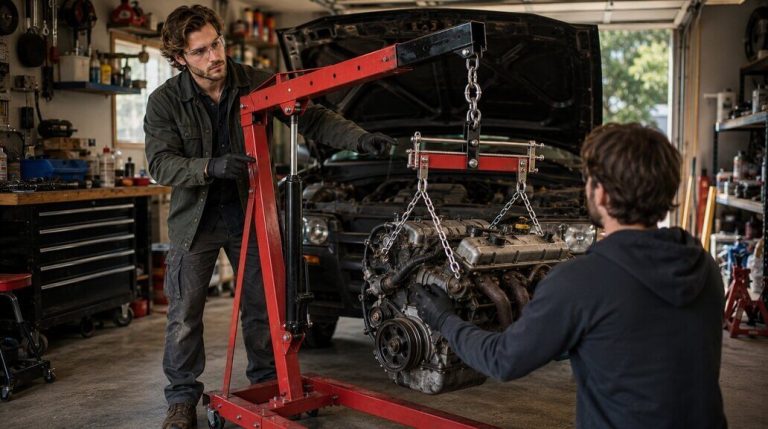
There is no shame in this, and it is part of doing the job safely. Get a second person, or a professional, when the engine is near your hoist’s rated capacity at the reach you need, when the vehicle sits on an imperfect surface you cannot fix, when you cannot find documented lift points, or when anything about the setup feels unstable. A helper who steadies and guides the load turns the riskiest moments, the move and the lower, into controlled ones.
Drive Toolkit publishes these guides to help home mechanics make safe, informed decisions. This checklist is general safety guidance, not a substitute for your specific engine hoist’s owner’s manual or your engine’s factory service information. When the two disagree, the manufacturer’s instructions win.
FAQ
How much weight can an engine hoist really lift?
Only what its load chart allows at the boom position you are using. A hoist rated 2 tons with the boom retracted may be safe for only around half a ton at full extension. Always read the rated figure printed on the boom for your reach, not the headline number, and keep the engine comfortably under it.
Do I need special chains to lift an engine?
Yes. Use rated lifting chains, slings, and hardware with a working load limit above the engine’s weight, attached to the engine’s designed lift points. OSHA rigging standards say chain slings must not be loaded past the rated capacity on their identification tag, and hooks and links must be rated at least as high as the chain. Skip tow straps, rope, and unmarked chain.
Can I use an engine hoist by myself?
You can rig and lift alone if the setup is well within capacity and the floor is level, but a second person makes the move and the lower much safer by steadying and guiding the load. For a heavy engine, a near-capacity lift, or any imperfect surface, get help.
Is it safe to leave an engine hanging on a hoist?
No. Never leave an engine suspended, even briefly. Hydraulic rams can lose pressure and lower a load on their own, and rigging can shift. Lower the engine onto a stand or blocks whenever you step away.
Why does my engine hoist’s capacity go down when I extend the boom?
Leverage. The further the load hangs from the hoist’s front legs, the more it tries to tip the crane forward, so the safe load drops at each extension step. That is exactly why the load chart on the boom lists a lower rating for every longer setting.
Sources
- OSHA 29 CFR 1910.184, Slings (rated capacity, identification, inspection, keeping employees clear of suspended loads, shock loading prohibited).
- OSHA 29 CFR 1926.251, Rigging equipment for material handling (alloy steel chain slings, hardware rating, clearance from loads).
- Manufacturer load-chart guidance and rigging practice on engine hoist capacity loss with boom extension (HeavyLiftDirect home engine hoist guide; The Garage Journal practitioner discussion).
- The Drive and NAPA Know How engine hoist procedure guides (staged lifting, walk-around checks, controlled lowering).