For most home garages, the best engine hoist is a folding 2-ton hydraulic floor crane, even if your engine is lighter than that. The number that matters is not the one printed on the box. It is the rated capacity at the boom length you will actually use, because that rating drops sharply as the boom extends. Beyond capacity, five things decide whether a hoist is worth owning: enough capacity headroom for your heaviest job, folding versus fixed legs for storage, honest build quality in the ram and welds, boom reach, and the caster wheels. Get those right and almost any reputable hydraulic crane will serve you for years.
This is a criteria guide, not a ranked leaderboard. We do not sell hoists and we have not bench-tested specific units, so instead of telling you which model to buy, we will show you exactly what to weigh so you can judge any hoist on the shelf yourself.
The number on the box is not the number you get
Here is the single most important fact competitors bury: a hoist’s headline rating is measured with the boom fully retracted, at its shortest reach. Extend the boom out to clear a fender or reach a longitudinal engine, and the safe capacity falls, often to a fraction of the label.
The reason is mechanical, not marketing. The hydraulic ram is a fixed-capacity cylinder. As the boom telescopes outward, the load sits farther from the lift point, so the same ram supports less weight. Every hoist has a rating plate or a stamped chart on the boom listing capacity at each position. A typical 2-ton folding crane looks roughly like this:
| Boom position | Approx. reach | Rated capacity |
|---|---|---|
| 1 (fully retracted) | shortest | ~2 tons (about 4,400 lb) |
| 2 | short-mid | ~1.5 tons (about 3,300 lb) |
| 3 | mid-long | ~1 ton (about 2,200 lb) |
| 4 (fully extended) | longest | ~0.5 ton (about 1,100 lb) |
Those figures are a common example of how these charts read, not a spec for one product. Your hoist’s own plate is the only number that counts. The takeaway is the same across brands: a “2-ton” crane can be a half-ton crane at full reach. This is why we recommend buying more capacity than your engine weight suggests. For a deeper walk-through of capacity math, see our guide on engine hoist lift capacity.
Buy capacity headroom, not a matching number
A small four-cylinder engine might weigh a few hundred pounds bare, and even a big V8 with accessories rarely approaches a ton. So a 1-ton hoist sounds like plenty. In practice, most home users are better off with a 2-ton.
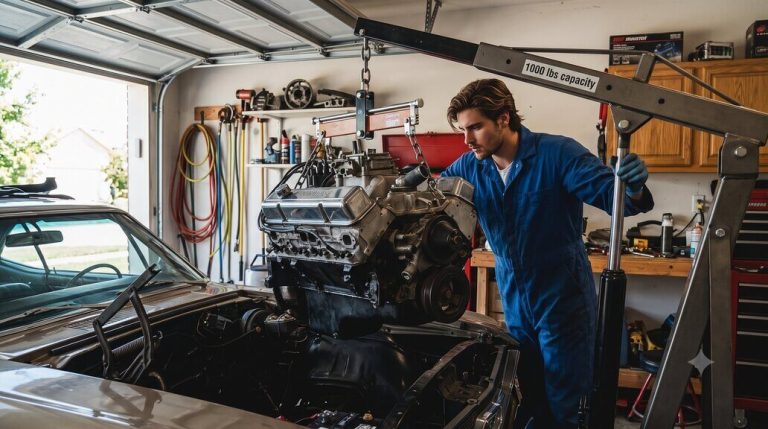
The reason is the chart above. If you buy a 1-ton hoist and then need to extend the boom to reach into an engine bay, your usable capacity can drop below what your engine actually weighs, right at the moment the engine is swinging in the air. Buying a 2-ton crane gives you real headroom so that even at a longer boom position you are still comfortably above your load.
A useful rule from the trade: leave at least a 25 percent margin over the heaviest thing you plan to lift, measured at the boom position you will use, not at position one. And never exceed the rated figure on the plate for that position. That plate is a hard limit, not a suggestion. To size against your specific engine, our post on what size engine hoist you need breaks it down engine by engine.
Folding versus fixed legs: the storage trade-off
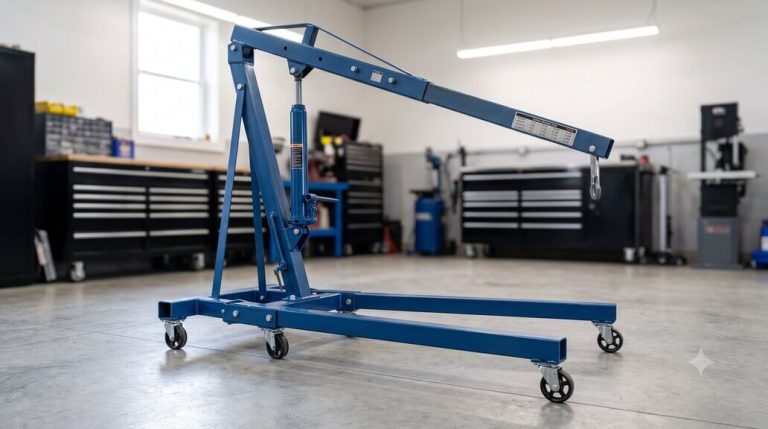
Most home garages do not have room to park a full-size crane between jobs. Folding hoists solve that. The legs and boom collapse so the unit stands against a wall or slides into a corner, which for a shared one-car or two-car garage is often the deciding feature.
The honest trade-off, which listicles skip: a folding hoist has more pivot points and pins than a fixed-frame one, so it can feel slightly less rigid under a heavy, swinging load. This is not a safety problem on a well-built unit used within its rating, but it is real. If you lift often and have the space, a fixed-leg crane is a touch more stable. If you lift once or twice a year and store the tool the rest of the time, folding is almost always the right call. Weigh it against how much the assembled and folded unit weighs, which our post on how much an engine hoist weighs covers for storage planning.
Stability: legs, spread, and the six-leg question
An engine hoist is a lever with a heavy weight hanging off the far end, so what keeps it from tipping is the leg base underneath. Look for wide-set legs that extend well past the boom’s reach, because a wider footprint resists the forward pull of an extended load.
Many quality cranes use a design where the front casters sit on outrigger legs and there are additional support points, sometimes described as a six-leg or wide-stance base. More contact points spread across a wider area mean a more planted feel when the load is out at reach. Whatever the leg count, the practical test is simple: at your longest boom position with a load, the hoist should feel planted, not nose-heavy.
The ram, the welds, and the boom
Build quality lives in a few specific places:
- The hydraulic ram. This is the part that does the work and the part that fails first on a cheap unit. A good ram lifts smoothly, holds position without creeping down, and lowers under control through its release valve. Slow seep or a spongy pump is a red flag.
- The welds and steel. Look at the boom-to-mast joint and the leg joints. Clean, consistent welds and heavier-gauge steel are what you are paying for at the mid and premium tiers over the cheapest units.
- Boom reach and positions. More boom positions give you finer control over reach versus capacity. A boom that reaches farther is handy for trucks and vans, but remember every inch of extra reach costs you capacity per the chart.
Casters and wheels: the cheap part that fails
The weakest point on many otherwise-decent hoists is the caster wheels, and it is the detail buyers notice last. Hard plastic or thin stamped-steel casters can crack, seize, or refuse to roll when loaded, especially on a rough or cracked garage slab. Since you steer a live load by rolling the whole crane, a stuck caster at the wrong moment is genuinely dangerous.
Prioritize steel or cast-iron caster bodies with wide wheels. Swivel casters at the front for steering and fixed at the back is a common, workable layout. If a hoist you like ships with weak wheels, upgraded casters are an inexpensive fix and worth doing before your first heavy lift.
Assembly and first use
Hoists ship unassembled and bolt together in under an hour with basic hand tools. Two things matter: torque the pivot bolts and pins properly so nothing works loose under load, and prime the hydraulic ram per the instructions (usually cycling it through a few no-load strokes) so it lifts smoothly the first time. Read the boom rating chart before you lift anything, and pair the hoist with a load leveler if you need to tilt the engine to clear the bay. We cover that accessory in our guide to the best engine hoist leveler.
Which type suits you
- First-time engine puller, tight garage: a folding 2-ton hydraulic crane. The capacity headroom covers you, and it stores away between jobs.
- Frequent user with space: a fixed-leg 2-ton crane for the extra rigidity, or a heavier folding unit if storage still matters.
- Occasional light lifts only: a 1-ton folding crane can work, but only if you stay at short boom positions and never approach the rating. For most people the 2-ton is worth it for the margin alone.
If you are still deciding between a floor crane and other lifting options, see our comparison of an engine hoist versus a shop crane versus a gantry crane.
A short buying checklist
Before you commit, confirm:
- The rating plate shows enough capacity at the boom position you will use, with roughly 25 percent margin over your load.
- It folds if your garage needs it to, and you know the folded footprint.
- The ram lifts smoothly and holds without creeping.
- The leg base is wide and feels planted at full reach.
- The casters are steel, not brittle plastic.
- Welds at the mast and legs look clean and consistent.
Safety comes before any purchase decision
An engine hoist lifts hundreds of pounds over your body and your vehicle. Never exceed the rated capacity for the boom position you are set to, never work under a suspended engine, support the load with stands where you can, and lower under control. A hoist bought with real capacity headroom is a safety decision as much as a value one. For the full procedure, see our guide on how to use an engine hoist safely.

Frequently asked questions
Is a 1-ton or 2-ton engine hoist better for a home garage?
A 2-ton is the safer default for most home garages, even though a typical engine weighs well under a ton. The reason is that rated capacity drops as the boom extends, so a 2-ton crane gives you real headroom when you have to reach into an engine bay. A 1-ton can work only if you stay at short boom positions and never approach the rating.
Why does an engine hoist’s capacity drop when you extend the boom?
Because the hydraulic ram is a fixed-capacity cylinder. As the telescoping boom reaches farther out, the load sits at a longer lever arm from the lift point, so the same ram can safely support less weight. Every hoist has a chart on the boom listing the safe capacity at each position, and a “2-ton” crane can fall to a half-ton at full extension.
Are folding engine hoists as good as fixed ones?
For home use, yes, within their rating. Folding hoists store far more easily, which is often the deciding factor in a small garage. The trade-off is that extra pivot points make them marginally less rigid than a fixed-frame crane under a heavy load. For occasional use that difference does not matter; for frequent heavy lifting, a fixed frame is slightly more stable.
What is the most common weak point on a cheap engine hoist?
The caster wheels. Hard plastic or thin stamped-steel casters can crack, seize, or refuse to roll under load, especially on a rough slab. Since you steer a live load by rolling the crane, a stuck caster is a real hazard. Steel or cast-iron casters are worth prioritizing or upgrading to.
How much capacity headroom should I leave?
Aim for at least 25 percent more rated capacity than the heaviest load you plan to lift, measured at the boom position you will actually use, not at the fully retracted position. And treat the number on the rating plate as a hard limit you never exceed.