An engine hoist leveler is the bar that hangs between your hoist hook and the engine, and it lets you tilt the engine nose-up or nose-down while it is in the air. That matters because an engine almost never balances level on a single hook. During removal and installation you need to tip it a few degrees to clear the transmission, the firewall, or the radiator support, and a leveler is what gives you that control without wrestling the whole load by hand.
When you are choosing one, the decisions that actually count are rated capacity to match your engine, whether the tilt mechanism is a geared handwheel or a simpler screw, and the reach and chain setup that let it bolt to your engine’s lift points.
Everything below is written to help you match a leveler to your job, not to sell you a specific model. We do not test these tools in a shop, so this is a criteria guide built from how the tool works and what its specs mean, not a “we ranked them” list.
Why a bare hoist hook is not enough
Picture the moment the engine breaks free of the mounts and starts to lift. The two or three points where your chains attach are almost never the same distance from the engine’s center of mass, so the engine swings and settles at an angle the instant it takes the full load. Now it is hanging nose-down, and the bell housing is jammed against the transmission or the oil pan is pointed straight at the core support.
With a bare hook, your only fix is to stop, set the engine back down, re-rig the chains, and try again. A leveler replaces that guesswork. You crank a handle or turn a screw, the balance point shifts along the bar, and the engine rotates in place while it stays in the air. That is the entire reason the tool exists: fine tilt control under load, without lowering and re-rigging.
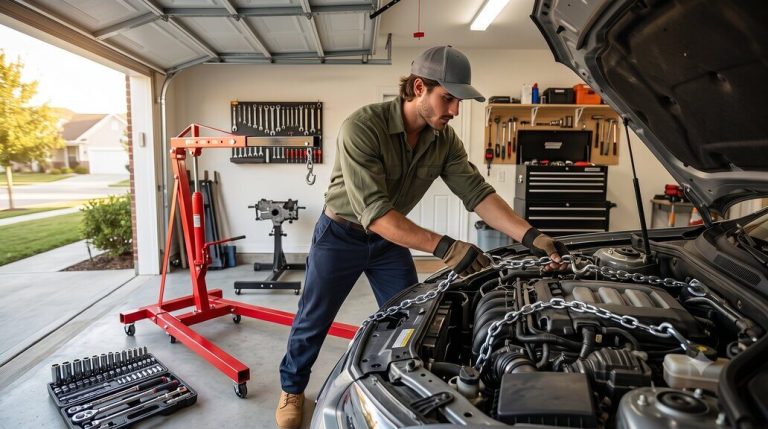
This is why we treat a leveler as close to essential for clean engine removal and replacement rather than a luxury add-on. You can pull some engines without one, but you will fight the angle the whole way, and fighting a swinging engine near painted panels and your own hands is exactly the situation you do not want to be improvising in. For the full lifting sequence, see our guide on how to use an engine hoist safely.
The criteria that actually matter
1. Rated capacity, matched to your real engine weight
This is the safety-critical number, so start here. A leveler carries the full weight of the engine, so its rated capacity has to meet or exceed what you are lifting, with margin to spare. Common levelers are sold in tiers such as 750, 1,250, 1,500, and 2,000 pounds, with heavy-duty units rated higher for truck and commercial work.
The trap is guessing the engine’s weight low. A dressed engine, meaning the block plus heads, intake, accessories, and often the transmission if you pull them together, weighs far more than the bare “long block” figure people quote. If you are unsure what your setup actually weighs, our breakdown of how much an engine hoist weighs and what different engines weigh walks through realistic figures. Pick a leveler whose rating clears your true, dressed weight, not the optimistic number.
One more point that gets missed: the leveler’s capacity and your hoist’s capacity are two separate ratings, and your safe working limit is whichever is lower. A leveler is not a place to save weight budget. Never load it past its stamped rating.
2. Geared handwheel vs simple screw adjustment
This is the difference you will feel on every single lift. Levelers adjust the balance point in one of two broad ways.
- Simple screw or slider: you turn a threaded rod or reposition a hook by hand. Cheaper, fewer parts, but you are applying the force directly, and under a heavy off-balance load that can be genuinely hard to turn.
- Geared handwheel (crank): a handwheel drives the mechanism through gearing, so a light turn of the wheel moves a heavy load. This is the feature most worth paying up for. Under a fully loaded, off-center engine, a geared handwheel lets you make a controlled adjustment with one hand instead of straining against the full weight.
If you expect to do more than one engine, or you are working alone, the geared handwheel is the upgrade that most changes how the job feels.
3. Chain quality, hooks, and mounting points
The leveler is only as trustworthy as the chains and hooks that connect it to the engine. Look for chain that is clearly rated for the leveler’s capacity, hooks or clevises that positively latch or bolt rather than just resting in place, and multiple mounting positions along the bar so you can space the attachment to match your engine’s factory lift points.
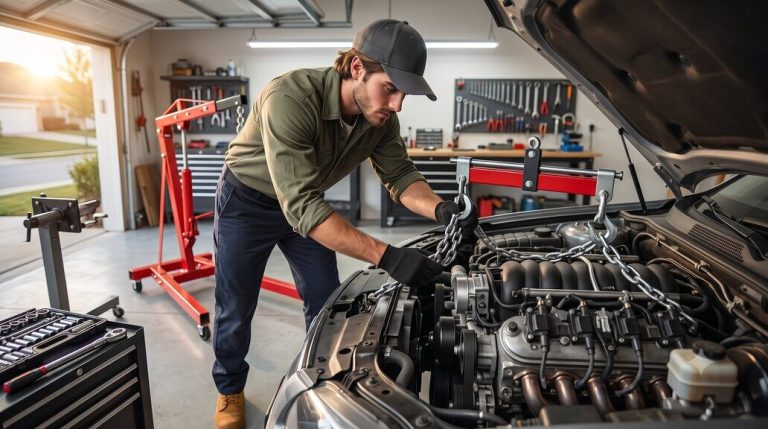
Attach only to the engine’s designed lift points, which are the cast lugs or bolt bosses the manufacturer put there for lifting, or to a proper lifting plate or bracket bolted to the block. Do not hook a chain around a fragile accessory, a coolant neck, or a wiring bracket. The lift points exist because they are structurally able to carry the whole engine; nothing else on the engine is guaranteed to.
4. Adjustment range and reach
Reach is how far the tilt range and the bar length let you shift the balance point. A wider adjustment range means you can compensate for a more off-center engine and hold a steeper angle to clear the firewall on a tight transverse (front-wheel-drive) installation. If you mostly pull inline engines straight up out of a roomy engine bay, a modest range is fine. If you work on V-configuration or sideways-mounted transverse engines that have to thread past a lot of obstacles, prioritize a longer bar and a wider tilt range.
5. Build and everyday durability
Look at the frame steel, the welds, and how the threaded parts are made. Solid steel construction and a coarse, well-cut thread (often described as an Acme-type thread) hold up better than thin stampings and fine hardware-store threads. This leads straight into the one thing most buying guides skip.
What nobody selling you a leveler will tell you
A cheap leveler with weak gears is a false economy. The failure people report most on the budget end is not a dramatic snap. It is the adjustment mechanism stripping or seizing. The threads gall, the gear teeth round off, or the handwheel starts to slip under load, and now you have a leveler that will not adjust at the exact moment you have a heavy engine hanging over your open engine bay. That is both the most useless time for it to fail and the most dangerous.
So the honest framing is this. A leveler is not the place to buy the absolute cheapest option to check a box. The whole value of the tool is smooth, controllable adjustment under a real load, and that is precisely the quality that gets cut to hit a rock-bottom price. You do not need the most expensive unit either. You need one whose rated capacity clears your true engine weight with margin, whose adjustment mechanism is built to turn under that load without stripping, and whose chains and hooks are rated to match. Spend where the load actually goes.
Do you even need one for your job?
Honestly, it depends on the engine and the space.
- Straight inline pulls out of a wide-open bay (for example, a small four-cylinder in an older rear-wheel-drive layout with the hood and front clip out of the way): you can sometimes manage with careful chain rigging, though a leveler still makes it faster and safer.
- V-configuration engines, transverse front-wheel-drive engines, or any pull where the engine has to tilt to clear the transmission or firewall: a leveler moves from “nice to have” to something you will want every time.
If you are still deciding on the hoist itself, start with choosing an engine hoist for a home garage, and if you are weighing different lifting setups entirely, see engine hoist vs shop crane vs gantry crane. A leveler pairs with any of them; it is the control layer, not the lift itself.
A short buying checklist
Before you buy, confirm each of these:
- Rated capacity clears your dressed engine weight with real margin, and never plan to exceed the stamped rating.
- Adjustment mechanism is a geared handwheel if you want easy, one-handed tilt under load; a plain screw is workable but harder.
- Chains and hooks are rated to the leveler’s capacity and latch or bolt securely.
- Mounting positions on the bar line up with your engine’s factory lift points.
- Tilt range and bar length suit your engine type (more reach for transverse and V engines).
- Build quality is solid steel with coarse, well-made threads, so the mechanism does not strip under a real load.
Frequently asked questions
What does an engine leveler do?
It hangs between your hoist hook and the engine and lets you tilt the engine nose-up or nose-down while it is in the air, so you can clear the transmission, firewall, and other obstacles during removal and installation without setting the engine down to re-rig your chains.
Do I really need a load leveler, or can I use just the hoist hook?
For a straight lift out of a wide-open bay you can sometimes manage with careful rigging, but for most real removals, especially V or transverse engines that must tilt to clear the transmission or firewall, a leveler is close to essential. It gives you controlled tilt under load instead of lowering and re-rigging repeatedly.
What capacity engine leveler do I need?
One whose rated capacity meets or exceeds your engine’s true dressed weight (block plus heads, accessories, and the transmission if you pull them together), with margin to spare. Remember your safe limit is whichever is lower, the leveler’s rating or the hoist’s rating. Never load a leveler past its stamped rating.
Is a geared handwheel worth it over a simple screw?
For most people, yes. A geared handwheel lets you adjust the balance point with a light one-handed turn even under a heavy off-center load, while a plain screw makes you apply that force directly. If you are working alone or doing more than one engine, it is the upgrade that most changes how the job feels.
Where do I attach the leveler chains on the engine?
Only to the engine’s designed lift points, which are the cast lugs or bolt bosses the manufacturer provided, or to a proper lifting plate bolted to the block. Do not hook onto accessories, coolant necks, or brackets, because only the designed lift points are guaranteed to carry the full engine weight.