If your engine hoist is losing pressure and the engine is sinking, stop and lower the load safely right now. Do not walk away from a suspended engine, and never put any part of your body under it. A hydraulic hoist that will not hold pressure is a lifting tool that has stopped being safe to trust, so get the engine down onto a stand or the block before you diagnose anything.
Once the ram is empty and unloaded, the usual causes are simple and cheap to fix: trapped air that needs bleeding, low or wrong hydraulic oil, and worn seals. Work through those in order, on an empty hoist, and most hoists come back to life.
That opening is the whole safety rule in one paragraph, and it matters more than any fix below. The rest of this guide walks through why a hoist loses pressure, how to tell which cause you have, and how to fix each one.
First, the safety rule nobody should skip
A hydraulic ram is designed to raise and lower a load, not to hold it in the air indefinitely. Standard hydraulic jack safety guidance is blunt about this: a jack is a lifting device, not a support device. Even a healthy hoist can creep down slowly over hours, and a hoist that is already losing pressure can drop far faster than that.
So the moment you notice sinking, the sequence is fixed:
- Keep everyone clear of the load and the boom swing.
- Lower the engine in a controlled way onto a stand, the engine block, or the ground.
- Only then start troubleshooting, with the ram empty.
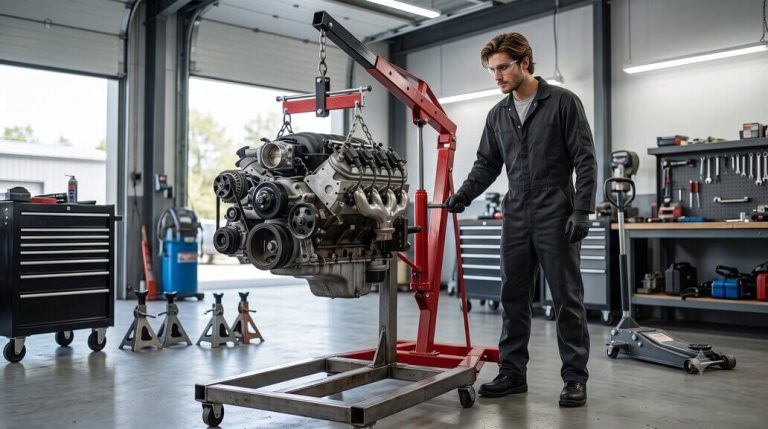
Never diagnose, bleed, or adjust a hoist while an engine hangs from it. If you want a fuller walkthrough of safe rigging and lowering, see our guide on how to use an engine hoist safely.
Cause 1: Air trapped in the hydraulic system (most common, easiest fix)
Air is the number one reason a hoist feels spongy, pumps but does not rise, or lifts partway and then settles. Hydraulic fluid does not compress, but air does, so any air in the ram acts like a soft spring under your load.
How to tell: the pump handle feels bouncy or “springy,” the ram lifts unevenly, or it rises a little and sinks back on its own. This is common on a brand new hoist, after the unit has been stored on its side, or after any repair that opened the system.
The fix, bleed the air: with the hoist empty, extend the ram close to its full height, then open the release valve and let the ram sink all the way down. Opening the valve while the ram is up lets trapped air work its way back to the reservoir. Cycle it up and down like this several times. If your model has a dedicated bleeder screw on the cylinder, extend the ram slightly to pressurize, then crack the screw about a half turn until air and a little fluid escape, and close it as soon as solid fluid appears with no bubbles. Repeat until the lift feels firm and rises smoothly. Always check the manual for your exact valve and screw locations, since designs vary.
Cause 2: Low or wrong hydraulic oil
If bleeding alone does not fix it, the reservoir may simply be low, or filled with the wrong fluid. Too little oil means the pump cannot build or hold enough pressure to lift, and it will often pull in air on every stroke, which loops you right back to the air problem above.
How to tell: the ram will not reach full height, lifting is weak from the very first pump, or you can see seepage around the base and fill plug.
The fix: with the ram fully lowered and the hoist empty and level, remove the fill or oil plug and check the level. Top up to the bottom of the fill hole with clean hydraulic jack oil. Do not substitute brake fluid, motor oil, or transmission fluid: they are the wrong viscosity, they can swell or attack the seals, and they are a common reason a “repaired” hoist fails again a week later. After topping up, bleed the system again, because adding oil almost always introduces a little air.
Cause 3: Worn or damaged seals and O-rings
Rubber seals and O-rings inside the ram harden, crack, and wear with age and use. When a seal starts to pass fluid internally, the hoist behaves in a very specific way: it lifts fine, holds for a moment, then bleeds down under load. This is the classic “sinks with an engine on it but seems okay empty” symptom, and it is why you always test on an empty hoist first.
How to tell: the ram lifts to full height and holds with no load, but sinks steadily once weight is on it, and topping up oil and bleeding air did not change that. External seal failure shows as oil weeping down the ram or pooling at the base. Internal failure can be silent, with no external leak at all.
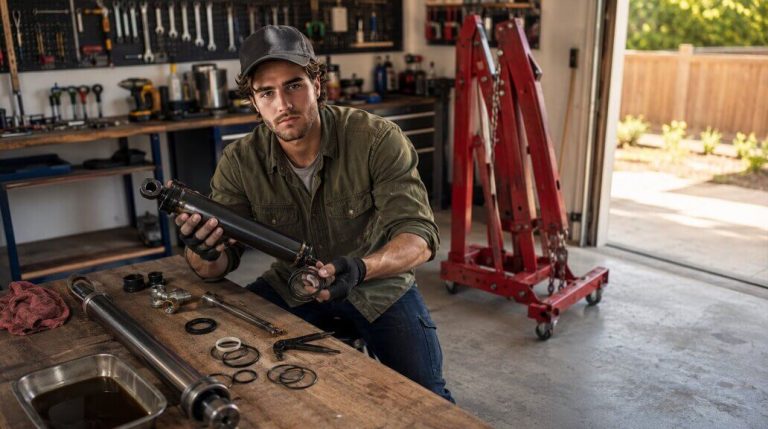
The fix: most hoists take a seal or rebuild kit made for that ram. Screw the release knob fully out, draw the rod out, and inspect the seals, the O-rings, and the cylinder bore. Replace the full set, not just the one part that looks worst. Be honest with yourself here: if the bore is scored or the rod is pitted or rusted, new seals will not seal against damaged metal for long, and a replacement ram or hoist is the better call. There is more on that judgment in the honest section below.
Cause 4: A failing or dirty release valve
The release valve is what you turn to lower the load, and it is also a quiet cause of pressure loss. If it is not seating fully, either because it is not closed all the way or because grit is holding it open, fluid leaks back past it and the ram sinks. This is worth a deliberate check because it is nearly free to fix and easy to mistake for a seal problem.
How to tell: the hoist will not build pressure at all, or it sinks steadily, and you notice the release knob feels gritty or does not tighten to a firm stop. On a first use, the simplest version of this is a valve that was never fully closed before pumping, so confirm it is snug first.
The fix: with the hoist empty, back the release knob all the way out and look for dirt or damage on the valve and its seat. Clean out any grit, wipe the seat, and reseat the valve. If the valve face or seat is chewed up, it is part of most rebuild kits. Reassemble, refill, and bleed.
Cause 5: A damaged ram or physical fault (not always hydraulic)
Sometimes the pressure problem is not inside the hydraulics at all. A ram that has been overloaded, side-loaded, or knocked can bend, and a bent ram binds instead of lifting cleanly. A load pushed past the rated capacity can also make a healthy hoist look like it is failing.
How to tell: the ram sticks, lifts crooked, or shows a visible bend or scoring on the shaft. Or the “failure” only appeared when you were lifting something heavy at full boom extension. Remember that a rated capacity is measured with the boom retracted: extend the boom to reach a truck engine and the safe capacity drops sharply. If you are unsure what your hoist can actually hold at your working length, read our breakdown of engine hoist lift capacity and how an engine hoist works so the numbers on the sticker make sense.
The fix: a bent or scored ram is a replacement, not a repair. If the real problem was overloading, the hoist may be fine once you work within its true rated capacity at your boom length.
The honest part: when a sinking hoist should never be used again
Here is the section most quick-fix articles skip. A hoist that sinks under load is not a hoist with a quirk you can manage around. It is a hoist that has failed the one job that keeps you alive, holding a heavy load steady, and it must be repaired and re-tested empty before it lifts another engine.
A few rules that are not negotiable:
- Never test a repaired hoist by hanging a real engine on it. If you want to confirm a fix, load it gradually with something you do not care about and can stand well clear of, or lift low and slow with the engine an inch off its mounts and your body out of the drop zone. Proving capacity with an engine in the air over your workspace is how people get hurt.
- A rebuild kit is cheap next to the alternative. A set of seals costs far less than a cracked block, a bent hood, or an emergency room visit. If the ram holds no load and you are tempted to “just watch it,” replace the seals instead.
- When in doubt, retire it. A scored bore, a pitted rod, a bent frame, or a hoist that keeps sinking after a proper rebuild has told you what it is. Replacing the tool is the responsible move. If you are shopping, our guide to the best engine hoist for a home garage covers what actually matters, and a matched engine hoist leveler makes controlled lifts far safer.
Quick recap
Lower the load first, always. Then, on an empty hoist, work in order: bleed trapped air, top up with the correct hydraulic oil and bleed again, inspect and replace worn seals, clean or reseat the release valve, and check for a bent ram or an overload. Most losses of pressure are air or oil, both cheap and fast. Seals are a real repair. A hoist that still sinks after a full rebuild has earned its retirement.
FAQ
Why does my engine hoist lift but then slowly sink under load?
That pattern almost always means an internal leak: worn seals or O-rings passing fluid inside the ram, or a release valve that is not seating. Test empty first. If it holds with no load but sinks with weight on it, plan on a seal or rebuild kit, and do not use it under a real load until it holds.
Can I just add more hydraulic oil to stop it sinking?
Only if the cause is low oil. Topping up helps a hoist that is genuinely low, but it will not fix worn seals or a bad valve. Use the correct hydraulic jack oil, never brake fluid or motor oil, and bleed the air out after refilling.
How do I bleed air from an engine hoist?
With the hoist empty, raise the ram near full height, open the release valve, and let it sink fully to send trapped air back to the reservoir. Cycle it several times. If there is a bleeder screw, crack it a half turn while the ram is slightly pressurized until solid, bubble-free fluid appears, then close it. Repeat until the lift feels firm.
Is it safe to keep using a hoist that loses a little pressure?
No. A hoist that cannot hold a load is not safe to lift with. Lower any load immediately, keep clear, and repair and re-test it empty before it lifts another engine. A jack or hoist is a lifting tool, not a holding tool.
What hydraulic fluid does an engine hoist use?
Use hydraulic jack oil, the same class of fluid used in bottle and floor jacks, and check your manual for the exact grade. Avoid brake fluid, motor oil, and automatic transmission fluid, which are the wrong viscosity and can damage the seals.