If you only ever pull small four-cylinder or compact V6 engines on their own, a 1-ton engine hoist has enough rated capacity for the job. If you work on anything larger, pull an engine with the transmission still attached, or simply want one hoist that will not run out of margin on the next project, a 2-ton is the safer default. The real decision is not “how heavy is my engine.” It is how much of your hoist’s rated capacity is left once the boom is extended far enough to actually clear the vehicle you are working on, and how much margin you want before you ever approach that number.
Ton rating is a unit, not one hoist’s promise
“Ton” is a unit of weight, not a brand’s marketing number. A US ton is 2,000 pounds, so a 1-ton hoist and a 2-ton hoist are, by definition, rated 2,000 pounds and 4,000 pounds respectively. What the label does not tell you is the condition that number applies under: it is the capacity at the boom’s shortest, most retracted position. Extend the boom out to reach a longitudinal engine or clear a fender, and the safe capacity drops, sometimes sharply, below that headline figure.
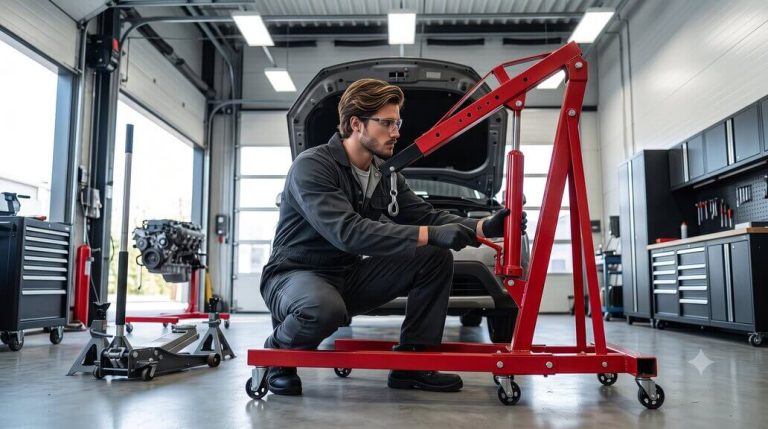
This matters because “1-ton vs 2-ton” is really two separate questions wearing one label: how much does my heaviest job weigh, and how far will I need to extend the boom to lift it. A 2-ton hoist gives you more room on both counts. Your own hoist’s rating plate or boom chart is the only source for what capacity remains at any given position; nothing general written here or anywhere else substitutes for reading it. For the full mechanics of why capacity falls as the boom extends, see our guide to engine hoist boom extension capacity.
What genuinely fits under a 1-ton hoist
A 1-ton hoist is not underpowered for everything. Bare four-cylinder engines, most compact V6s pulled without a transmission, motorcycle engines, and small industrial or marine engines sit comfortably within a 1-ton rating even after accounting for some boom extension. If your garage work is limited to one or two lightweight engine families and you already know their approximate weight class, a 1-ton hoist can be the right tool, and it is usually lighter and cheaper to store.
The catch is “usually” doing a lot of work in that sentence. A 1-ton hoist gives you very little room for surprises: an engine that turns out heavier than expected once accessories, a flywheel, or a bellhousing are still attached, or a boom position longer than you planned for, can put you close to or past the rated limit fast. Our post on engine hoist lift capacity walks through how to actually estimate what you are lifting before you commit to a rating.
Why most home garages land on 2-ton anyway
The pattern across owner forums and buying guides is consistent: people who start with a 1-ton hoist because their first job was small often end up wishing they had bought a 2-ton the moment a second, heavier project comes along. A garage rarely does exactly one type of engine work forever. The next job might be a V8, a truck engine, or a pull with the transmission still bolted on, and none of those belong anywhere near a 1-ton’s limit.
Buying the 2-ton the first time removes that guesswork. It is not about needing 4,000 pounds of capacity for a 400-pound engine. It is about having genuine headroom at whatever boom position the job actually requires, so you are never lifting close to the plate’s number. That headroom is the entire safety argument, not an upsell. Our complete buying guide covers the rest of what separates a good 2-ton hoist from a mediocre one once you have settled on the rating.
The number that matters more than tonnage: your real boom position
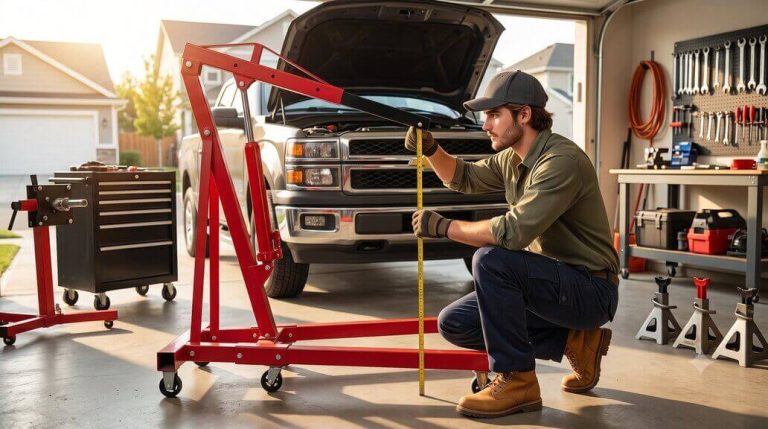
Here is the part almost every “1-ton vs 2-ton” comparison skips entirely: the tonnage on the box assumes the shortest boom position, and that is rarely the position you will actually use. A longitudinal engine, a truck with a tall front end, or simply the geometry of your specific garage bay can force you out to a longer boom position, where the same hoist’s real capacity is meaningfully lower than its printed rating.
This means the honest version of the 1-ton-vs-2-ton question is really: “at the boom position my job will require, does this hoist’s rated capacity for that position comfortably clear my engine’s weight, with margin?” A 2-ton hoist buys you more room to answer yes even at a longer reach. A 1-ton hoist can still answer yes, but the margin for error is thinner, and it disappears faster as the boom extends. Read your hoist’s own boom-position chart before any lift. Never estimate this from a general number, including any of the ones in this article.
The 1-ton’s real advantage: weight and solo maneuverability
The case for a 1-ton is not only price. A 1-ton hoist is generally the lighter of the two to build, wheel, and store, and that matters if you work alone, have a small garage, or move the hoist in and out of storage between jobs by yourself. A heavier 2-ton frame with a wider stance can be genuinely awkward to maneuver solo on an uneven or cracked slab.
If maneuverability and storage footprint matter as much to you as capacity margin, that is a legitimate reason to choose 1-ton for genuinely light work rather than defaulting to 2-ton out of habit. Weigh this honestly against your actual jobs, not against a hypothetical future truck engine you may never pull. Caster quality affects this trade-off more than most buyers expect; see our piece on engine hoist caster wheels for what actually makes a hoist easier or harder to move once loaded.
A short decision checklist
Before you choose a rating, work through this in order:
- List the heaviest realistic job you expect in the next few years, not just your next one.
- Estimate that engine’s weight with accessories and, if relevant, the transmission attached.
- Work out the boom position your garage geometry and that vehicle will actually require.
- Check whether a 1-ton hoist’s capacity at that position clears your estimate with real margin.
- If it does not, or if you are unsure, buy the 2-ton.
- If storage space or working alone is a genuine constraint and your jobs are consistently light, a 1-ton remains a reasonable, honest choice.
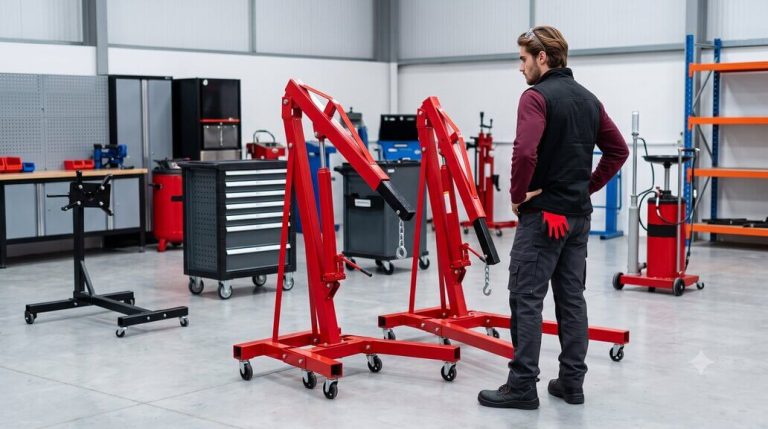
If your project is a single, one-time pull rather than an ongoing garage habit, it is also worth asking whether owning either size makes sense at all. See our honest breakdown of renting vs. buying an engine hoist.
Frequently asked questions
Is a 2-ton engine hoist overkill for a small engine?
Not in practice. The extra rated capacity is about margin at whatever boom position the job requires, not about needing the full 4,000-pound figure. A small engine lifted on a 2-ton hoist is simply lifted with more headroom than the same engine on a 1-ton.
Can a 1-ton hoist lift a V8?
It depends entirely on the specific engine’s weight, whether the transmission is attached, and the boom position the job requires. Check your hoist’s own rating plate at that position rather than assuming. Many V8s, especially with a transmission still bolted on, are closer to or past what a 1-ton hoist comfortably handles with margin, which is why most buyers doing V8 work choose 2-ton.
Does a 2-ton hoist cost much more than a 1-ton?
Prices vary by brand and retailer, and we do not track live pricing here, so compare current listings yourself before deciding on cost alone.
Why do people recommend 2-ton even for light engines?
Because the rating on the box is the shortest-boom number, and real jobs often require extending the boom. Buying 2-ton gives you margin at longer boom positions where a 1-ton’s usable capacity has already fallen closer to its limit.
What if I’m not sure how heavy my engine is?
Look up your engine’s published curb or dressed weight from a manufacturer source or an established reference before you lift anything, rather than guessing. Our guide on what size engine hoist you need walks through sizing engine by engine.