Yes, it is normal for stock caster wheels to be the weakest part of an engine hoist, and this shows up consistently across owner discussions of the tool. The casters that ship on many hoists are small, hard-wheeled, and built to a price, not to the job of steering hundreds of pounds across a garage floor. That would just be an annoyance if it happened with the hoist empty. It becomes a safety issue when it happens with an engine hanging from the boom, because a wheel that will not roll or swivel forces you to fight the hoist’s position while a suspended load is in motion.
The three ways caster wheels actually fail
Owner reports converge on three distinct patterns, and it is worth telling them apart because each has a different cause:
- Won’t swivel under load. The wheel rolls fine when the hoist is empty but locks up or drags once weight is on it. This usually points to an undersized swivel bearing or a caster simply not rated for the load it is being asked to carry.
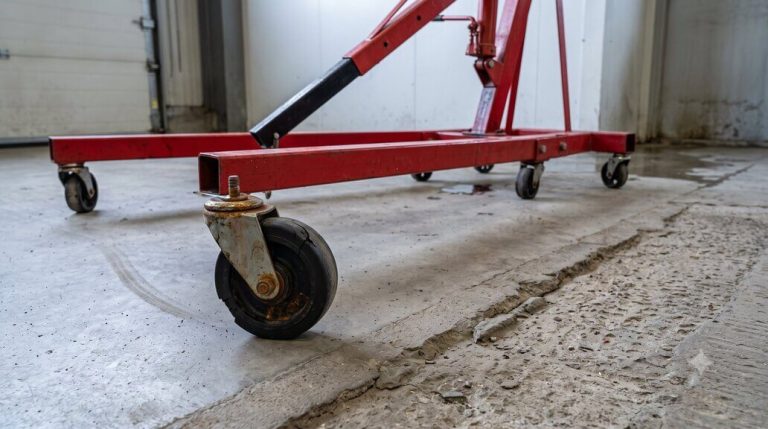
- Won’t roll at all, loaded or not. Often dirt, grit, or hair wound into the wheel axle, or a wheel material too hard and narrow to roll smoothly on a rough or cracked concrete slab.
- Cracks, seizes, or degrades over time. Cheap plastic or thin stamped-steel wheel bodies can crack under repeated load cycles, or the axle can corrode and seize from garage moisture and debris.
Telling these apart matters because the fix is different for each: a maintenance issue does not need a replacement part, and a load-rating issue will not be solved by cleaning.
Why this matters more under load than it looks like it should
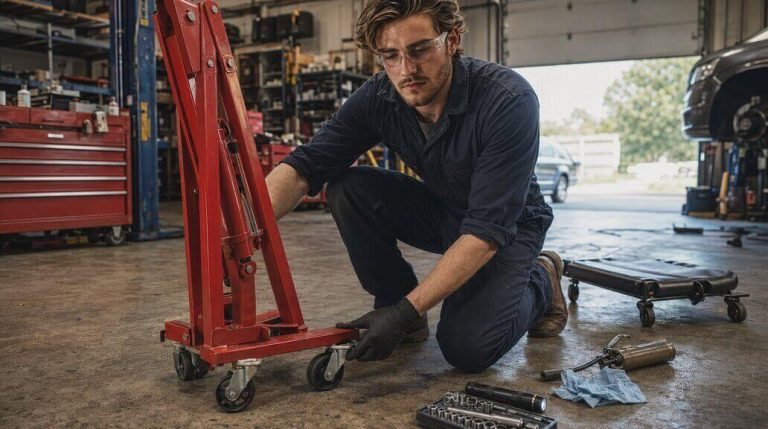
Here is the detail most casual advice skips: when an engine hoist is loaded, the weight distribution across its wheels is not even. A large share of the load sits on the front two casters, the ones nearest the boom, which is exactly why those are the wheels that wear out and fail first. A caster that seizes on an empty hoist is an inconvenience. The same caster seizing while an engine is suspended and you need to reposition the hoist is a genuinely different situation: you are now trying to force a stuck wheel while a live load hangs in the air, which is precisely the kind of moment our safety checklist tells you to avoid entirely by planning your position before you lift, not during it.
If a caster is dragging, sticking, or refusing to swivel at all, the correct response is to lower the load to a stand or the ground first, then address the wheel. Never try to work a stuck caster free while an engine is still hanging from the hoist.
What generally makes a caster more durable
We have not tested specific caster products or brands, so nothing here is a recommendation of one part over another. This is general material and design knowledge reported consistently across owner discussions of the tool, offered as a framework for judging what you already have or are shopping for:
- Wheel material. Rubber or polyurethane-tired wheels are commonly reported to roll more smoothly across concrete than hard plastic or bare steel, which tend to transmit every crack and pit in the floor into resistance.
- Wheel body construction. Solid or reinforced wheel bodies hold up better to repeated loaded use than thin stamped components, which is consistent with basic material logic rather than any test we have run.
- Swivel bearing quality. A caster rated for the hoist’s full load, with a bearing built for that load, is less likely to bind under weight than an undersized one.
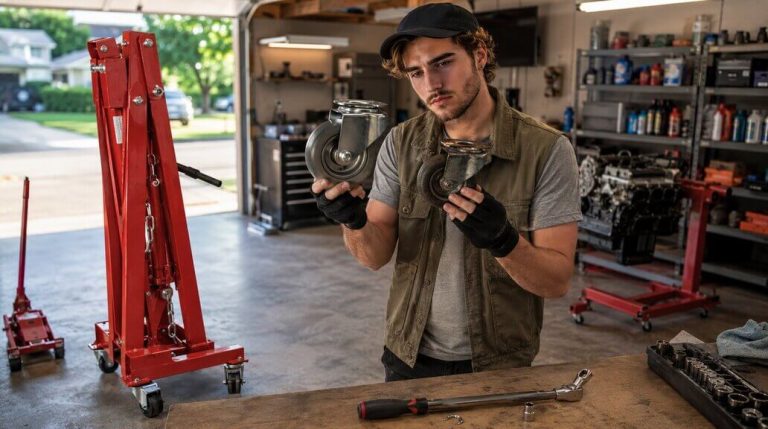
If your hoist’s stock casters are giving you consistent trouble, replacing them with better-rated casters is a widely reported fix in owner communities, and it is a comparatively inexpensive one relative to the hoist itself. That said, any replacement caster should be rated for at least the hoist’s full capacity. This is not a place to guess at a rating either. Storage habits also affect how long casters last; see our comparison of folding vs fixed hoists for how a hoist is stored and moved between uses.
Maintenance that prevents most problems before they start
Most caster trouble that is not a rated-capacity issue can be prevented or delayed with basic upkeep: clear debris and hair wound around the axle periodically, keep the wheel and swivel mechanism lightly lubricated per any manufacturer guidance, and inspect for cracking or flat-spotting before it becomes a mid-lift surprise. None of this requires special tools, and doing it on a schedule is cheaper than discovering a seized caster with an engine in the air.
When to stop and inspect before your next lift
Treat any of the following as a reason to inspect and, if needed, replace casters before your next lift, not after:
- A caster visibly drags, sticks, or resists turning when you roll the empty hoist.
- You can see cracking, flat spots, or corrosion on the wheel body.
- The hoist has sat unused for an extended period, especially in a damp or unheated space.
- You are about to move to a rougher or more uneven section of floor than usual.
If a hoist with a suspect caster is also showing other signs of trouble (for example, the boom or ram itself not holding position), treat that as a separate and more urgent issue. See our guide on an engine hoist losing pressure if that is what you are seeing.
Frequently asked questions
Why do engine hoist casters fail before anything else on the tool?
Because a large share of a loaded hoist’s weight concentrates on the front casters, and many stock wheels are built to a price rather than to that load. They see more repeated stress than most other components on the frame.
Is it safe to keep using a hoist with a sticky caster?
Not while loaded. Lower the load to a stand or the ground first, then address the caster. Never try to force a stuck wheel while an engine is suspended from the boom.
What wheel material rolls best on a garage floor?
Owner reports consistently favor rubber or polyurethane-tired wheels over hard plastic or bare steel for rolling smoothly on typical concrete, though we have not bench-tested this ourselves and it is general material behavior rather than a specific brand recommendation.
How do I know if my caster problem is dirt or a real defect?
Clean the axle and wheel of debris first and re-test empty. If it still drags or will not swivel after cleaning, the issue is more likely a bearing, load rating, or material defect rather than dirt.
Should I replace all four casters or just the ones that fail?
Since front casters typically carry more load and wear faster, it is common to replace those first, but check all four for wear and make sure any replacement is rated for the hoist’s full capacity, matched in pairs where the hoist’s design calls for it.