An engine hoist needs flat, hard, level ground to operate safely, and concrete is the standard for a reason. Gravel and a sloped driveway are not the same problem, and it matters that you tell them apart before deciding whether your driveway is safe to lift on at all. Gravel is unstable and uneven under a hoist’s wheels; a slope changes where the load’s weight actually sits relative to the hoist’s base. Either one alone is a real hazard with a suspended engine. Both together are a strong reason to find a different location.
Why flat, hard ground matters mechanically
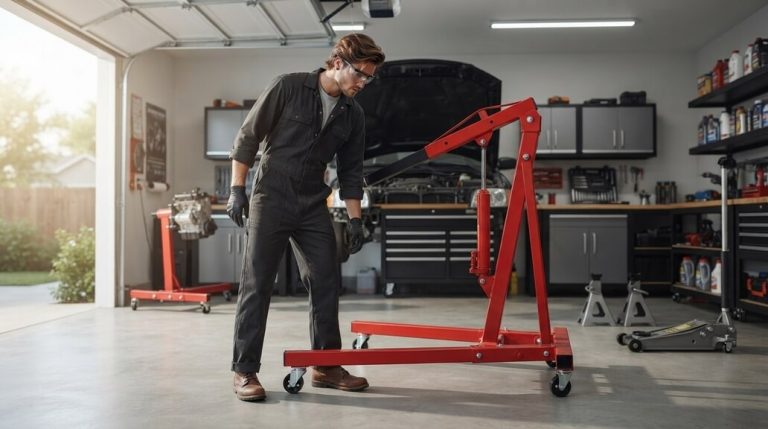
An engine hoist is a lever with a heavy, moving load hanging off the far end, and what keeps the whole thing from tipping or rolling out of control is the leg base and the wheels underneath it. That system is engineered to work on a flat, hard, predictable surface. Every assumption behind the hoist’s stability (that the legs stay level, that the wheels roll where you steer them, that the load’s position relative to the base stays where you expect) depends on the ground actually behaving that way.
Change the ground and you change all of those assumptions at once, while an engine is in the air. That is the core reason concrete, or an equivalent flat, hard, level surface, is the standard recommendation, not an arbitrary preference.
Why gravel specifically is a problem
Gravel is a problem primarily because it is not a fixed surface. A caster wheel can sink slightly, shift, or roll unevenly on loose stone in a way it never would on a solid slab, and that unevenness is unpredictable from one moment to the next as you move the hoist. Because a large share of a loaded hoist’s weight sits on the front casters, any give or shift under those wheels while an engine is suspended is a direct threat to control of the load, not a minor inconvenience. Our piece on engine hoist casters covers how much stability depends on the wheels functioning correctly even on good ground; gravel removes that reliability entirely.
Why slope is a separate and additional hazard
A sloped surface is a distinct problem from an unstable one. Even on hard, compacted ground, a slope shifts where the load’s weight sits relative to the hoist’s leg base, which is exactly the geometry that keeps the hoist from tipping in the first place. An engine that swings even slightly on a sloped surface can shift the combined center of gravity of hoist and load toward the downhill side, and a hoist that would be perfectly stable on flat ground can become genuinely tip-prone on even a modest slope.
Gravel and slope frequently occur together on a driveway, which compounds both problems: an already unstable surface underneath a load whose stability margin has already been reduced by the incline.
If you have no concrete pad: what owners commonly do
If a flat garage slab genuinely is not available, some owners report laying down solid boards or sheets of plywood to create a firm, flat track for the hoist’s wheels to roll on over gravel, or using thick rubber mats for the same purpose. Others simply move the vehicle to a flat concrete area, such as a driveway apron or a nearby paved surface, rather than trying to make an unsuitable surface work. We have not tested any specific board, mat, or product for this purpose ourselves, so this is presented as a commonly reported practice, not a recommendation of any particular material or brand.
Whatever surface preparation you use, the ground underneath it still needs to be genuinely level, not merely covered. A board laid over a sloped or uneven patch of gravel does not correct the slope; it only changes what the wheels are rolling on.
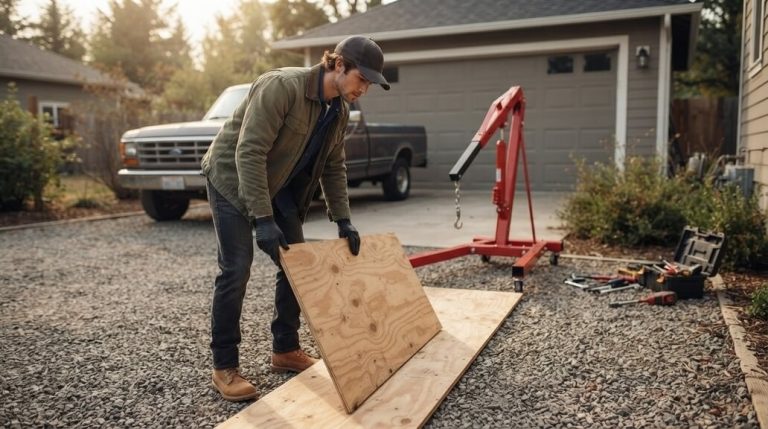
It is also worth thinking about weather and moisture at this stage. Boards and mats laid outdoors can shift, warp, or become slippery if they get wet between the time you set them down and the time you actually lift, so check them again immediately before the lift rather than trusting how they looked when you placed them. A surface that was adequate an hour ago is not guaranteed to still be adequate once conditions change, and re-checking costs you nothing compared to the alternative.
When the honest answer is not here, or not without help
Some situations do not have a safe workaround. If your only available space is meaningfully sloped, consistently soft or shifting underfoot, or you cannot confirm it is level without guessing, the honest answer is to find a different location entirely (a friend’s garage, a rented bay, or a paved area you have confirmed is flat) rather than attempting the lift where you are. No amount of careful technique corrects for genuinely bad ground under a suspended engine. Our full safety checklist covers the rest of what a safe lift requires once the ground itself is sound, and our buying guide is worth reading if you have not yet settled on which hoist to use in the first place. If storage and workspace constraints are part of why you are considering an outdoor lift, our comparison of folding vs fixed hoists may help you plan around a tighter garage instead.
Pre-lift ground check
- Confirm the surface is hard and stable, not loose gravel, dirt, or anything that can shift under a wheel.
- Confirm the surface is genuinely level, checked rather than assumed by eye.
- If using boards or mats over an imperfect surface, confirm the underlying ground is still level, not just covered.
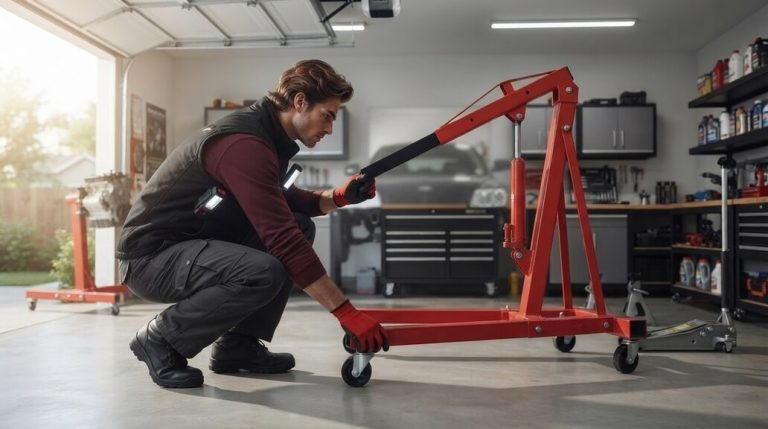
- Walk the hoist’s full range of motion for the lift, empty, before loading it, to check for any wheel drag or instability.
- If you cannot confirm both flat and stable, move the lift to a different location rather than proceeding.
Frequently asked questions
Can I use an engine hoist on a gravel driveway at all?
Only if the gravel is compacted, genuinely level, and you take steps to give the wheels a firm, flat surface to roll on, such as solid boards. Loose or uneven gravel underneath a suspended load is a real hazard, and if you cannot confirm the ground is both stable and level, do not attempt the lift there.
Is a slight slope on my driveway actually dangerous?
Yes, more than most people expect. A slope changes where the load’s weight sits relative to the hoist’s leg base, which can meaningfully reduce the hoist’s tipping stability compared to flat ground, even if the slope looks minor.
What can I put down to make gravel safe for an engine hoist?
Some owners report using solid boards, plywood, or thick rubber mats to create a firmer track for the wheels. We have not tested specific products ourselves, and any surface preparation still requires the ground underneath to be genuinely level, not just covered.
Is it better to move the car to a flat surface than to lift on a bad one?
Often, yes. If a flat, hard, level surface is available nearby, even if it means moving the vehicle there first, that is generally the more straightforward solution than trying to make an unsuitable surface work.
How do I know if my driveway is level enough?
Check with a level rather than judging by eye, across the full area the hoist will move through during the lift, not just where it starts. If you are unsure, treat the location as not suitable and find flatter ground.