Are you staring at a big motor right now? You might ask what size engine hoist do I need. For most home shops in the US, a two ton lift is the best pick.
I have pulled out many heavy truck blocks in my life. Buying a weak lift is a bad choice. Read on to find the right tool for your job.
Why Engine Hoist Size Matters More Than You Think
A quick reality check before you pick a hoist—because guessing here can end very badly.
Picture this. It is a warm Saturday afternoon in my garage. I am sweating through my shirt. I am halfway through pulling an old engine out of a project car. I pump the handle. The motor lifts an inch. Suddenly, the hoist starts groaning. The metal actually squeaks under the heavy load. The front wheels dig hard into the concrete floor.
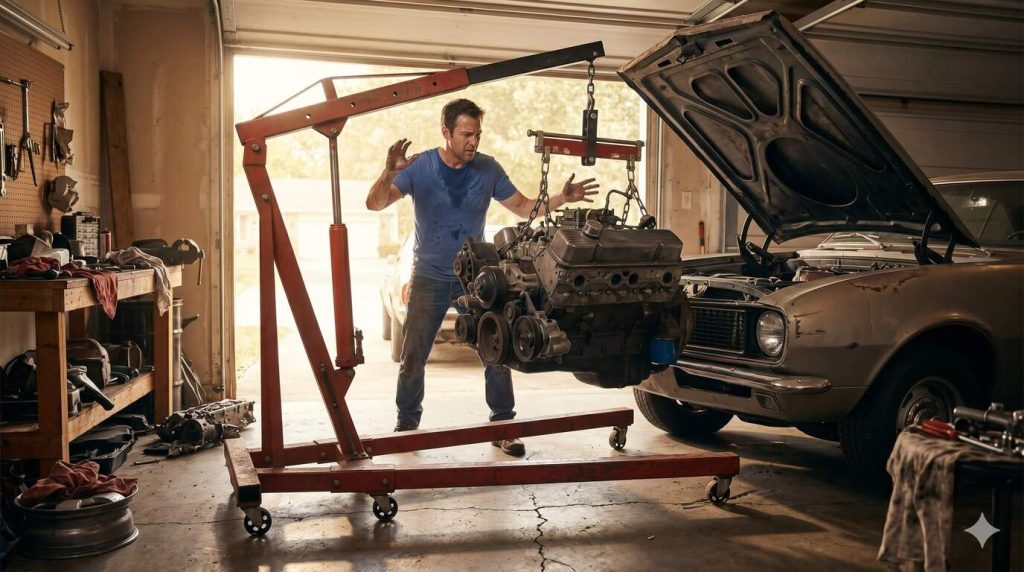
My heart instantly dropped into my stomach. I carefully backed away, afraid the whole rig was going to snap. That is the exact moment you realize why knowing exactly what size engine hoist do I need is so crucial. Guessing is a gamble you simply do not want to take.
The Danger of Going Too Small
I have watched guys try to save a few bucks with a tiny, cheap hoist. It is terrifying.
- Dropped engines: A failing hoist can drop hundreds of pounds of dirty iron. That means a smashed oil pan, cracked concrete, or a very expensive hospital bill.
- Broken parts: Push a small hoist too far, and the steel boom bends. Or worse, the hydraulic ram blows a seal halfway through the lift.
The Headache of Going Too Big
So, you should just buy the biggest heavy-duty crane you can find, right? Well, I tried that route once, too. It has its own frustrating downsides.
- Zero storage: A massive hoist eats up half your garage. Even folded up, it is a giant hurdle.
- Hard to maneuver: Trying to steer a heavy, oversized steel frame around a tight two-car garage feels like parking a bus in a closet.
The goal is to find the perfect middle ground. You want a hoist that is strong enough to be safe, but small enough to actually use.
| Your Hoist Choice | What Actually Happens | How You Feel |
| Undersized | Bent metal boom, blown seals, risk of drops. | Pure panic and sweat. |
| Oversized | Tripping over legs, hard to push, no space. | Annoyed and frustrated. |
| Right-Sized | Smooth lifting, safe reach, easy to store. | Confident and stress-free. |
The 3 Things That Actually Decide What Size You Need
Ignore the shiny stickers on the box. Sales tags lie. Focus on these three real factors.
Engine Weight (Start Here, Always)
I once lifted a dirty V8 thinking it was light. My back hurt for days. You must know your starting weight.
| Engine Type | Average Weight |
| 4-cylinder | 250 to 350 lbs |
| V6 | 300 to 450 lbs |
| V8 | 400 to 700 lbs |
| Diesel | 700 to 1,500+ lbs |
Do not forget the heavy extras. Alternators, iron parts, thick fluids, and the gearbox add massive weight fast.
My simple rule: Always add 20 to 30 percent extra weight to your math. Keep it safe.
Boom Position (The Hidden Lift Killer)
This is the biggest trap. A box rating is rarely your real lifting power.
I learned this on a cold Tuesday night. I slid the heavy metal arm all the way out to reach my truck motor. When you pull the boom out, lift power drops fast.
- Short arm setting: Full 2-ton power.
- Fully long setting: Drops to 1 ton or less.
You almost always have to pull the arm out to reach the block. So, when asking what size engine hoist do I need, know that the “2-ton” label is a trick.
Vehicle Type & Engine Bay Space
What sits in your driveway changes the game.
- Small cars: Short noses mean easy access. You do not reach far.
- Trucks and SUVs: Deep bays force you to pull the arm way out. This kills your safe lift limit.
Also, think of your floor space. In a tight garage, you feel the pain instantly. It sucks when the hoist legs smack your tires before the hook even gets to the motor.
Common Engine Hoist Sizes Explained (With Real Use Cases)
When figuring out what size engine hoist do I need, let’s break down what each size really means in your garage. Forget the spec sheet. Here is how they actually feel to use.
1-Ton Engine Hoist
I bought a 1-ton hoist on a bright Sunday morning for a tiny hatchback build. It felt like a smart, cheap choice at the time.
- Best for: Stripped-down 4-cylinders and very light V6 motors.
- The limit: It hates long reaches. When I pulled the boom arm out to the last hole, the thin metal frame visibly flexed.
It works fine for a tiny car. But the second you need just an inch more reach, you will hold your breath and pray it holds together.
2-Ton Engine Hoist (Most Popular Choice)
This is the one. I finally upgraded to a 2-ton model after that scary flex. I felt so much relief hearing the smooth, quiet lift under a heavy load.
- Best for: Almost 90% of home mechanics.
- Handles: Heavy V8s, wide V6s, and most normal truck blocks.
- Why it wins: It hits the perfect sweet spot. You get real lifting power and safety, but you can still fold it up and roll it away.
Trust me on this. This is the exact size most people wish they bought first.
3-Ton Engine Hoist (Heavy-Duty Option)
My buddy bought a massive 3-ton hoist for his diesel shop. I helped him put it together. We both grunted and sweat just pushing the empty frame across the concrete.
- Best for: Massive diesel truck engines or daily commercial use.
- The downside: It is a monster. It is heavy, clunky, and it eats up a massive amount of floor space.
- The rule: If you truly need a 3-ton hoist, you already know it. For a normal home garage, it is pure overkill.
| Hoist Size | Best Fit For | The Real Downside |
| 1-Ton | Tiny cars, bare 4-cylinders | Gets scary at full reach. |
| 2-Ton | V8s, home garages, 90% of jobs | Slightly heavier to roll. |
| 3-Ton | Huge diesels, big shop floors | Eats all your garage space. |
Is a 1-Ton Engine Hoist Enough? (Honest Answer)
I get asked this question all the time. Is a 1 ton engine hoist enough? The short and honest answer is sometimes. But really, it is a huge gamble.
I started out with a shiny blue 1-ton hoist in my old, dusty garage. I just wanted to save a few bucks. It worked great for my first small job. But I quickly learned its hard limits.
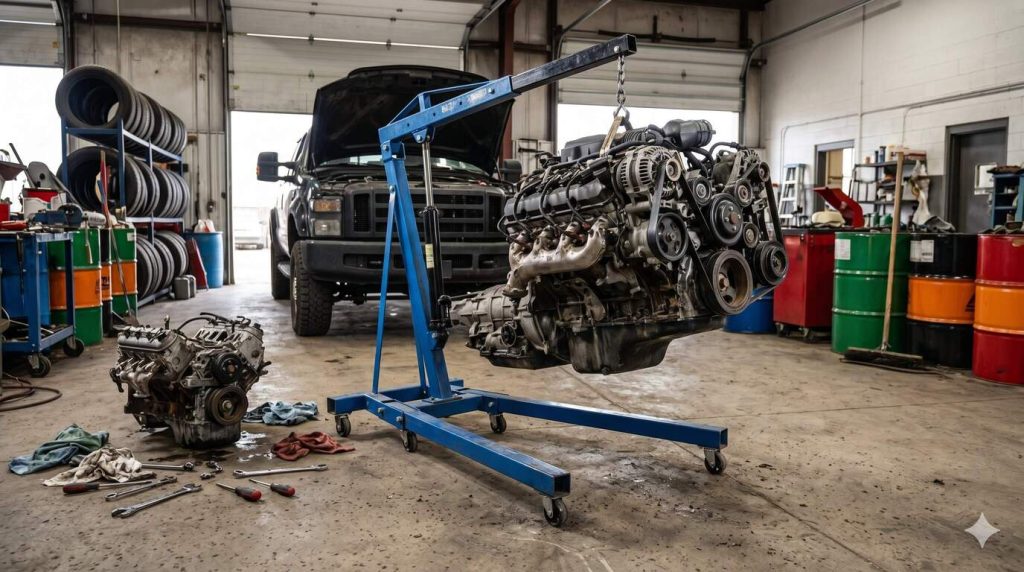
When it is actually enough:
- You are only lifting small, bare engines.
- You do not need to pull the boom arm out very far.
When it is definitely NOT enough:
- You are working on heavy trucks or SUVs.
- You have a wide engine bay that forces a very long reach.
The sad truth is that most guys outgrow a 1-ton hoist super fast. You buy it for a tiny car today. But next month, your buddy needs help fixing his big truck. Suddenly, your small hoist is totally useless. You are stuck standing there, holding a greasy wrench, just shaking your head.
My strongest recommendation? Skip the 1-ton completely unless you are 100 percent sure you will never lift anything bigger than a bare 4-cylinder motor. It is simply not worth the stress.
| Will a 1-Ton Work? | The Honest Truth |
| Small Hatchback | Yes, it will work fine. |
| Mid-Size Sedan | Maybe, but it will be a very close call. |
| Truck or SUV | No. Do not even try it. |
How Big of an Engine Hoist Do I Need for My Vehicle?
Let us stop guessing. If you are asking how big of an engine hoist do I need, we must look at what actually sits in your driveway. I have pulled motors out of almost everything. Here is what truly works.
Small Cars (Civic, Corolla, etc.)
I pulled a tiny motor from a rusty Honda Civic last month. The front end is short. The block is light.
- The bare minimum: A 1-ton hoist will get the job done.
- The safer choice: A 2-ton hoist is still better. The metal flexes much less.
Sedans & Crossovers
These cars have longer noses. You must reach much deeper over the front bumper.
- My top pick: Always use a 2-ton hoist.
- Why it matters: You need that extra boom reach and flexibility so you do not smash your plastic grille.
Pickup Trucks & SUVs
I lifted an old iron V8 out of a dusty Chevy truck last summer. You feel that massive weight instantly in the pump handle. It actively fights you.
- For gas trucks: You need a 2-ton hoist at the absolute minimum.
- For diesel trucks: You must step up to a heavy 3-ton hoist.
Engine + Transmission Together
Pulling the block and the gearbox together is a classic garage move. It saves you hours of tight wrenching. But it adds crazy weight. My hands were covered in black grease the first time I did this, and my small hoist literally screamed.
- The only safe way: Stick to a 2-ton or 3-ton hoist only.
- The golden rule: Never risk a 1-ton hoist here. You are just begging for a snapped boom arm.
| Your Vehicle Type | Minimum Hoist | The Safest Choice |
| Small Commuter Car | 1-Ton | 2-Ton |
| Normal Sedan or SUV | 2-Ton | 2-Ton |
| Full-Size Truck | 2-Ton | 3-Ton |
| Engine + Transmission | 2-Ton | 3-Ton |
Mistakes People Make When Choosing an Engine Hoist
I have made almost every mistake you can make in a dirty garage. When you finally sit down to figure out what size engine hoist do I need, avoiding these common traps will save you real money and massive headaches.
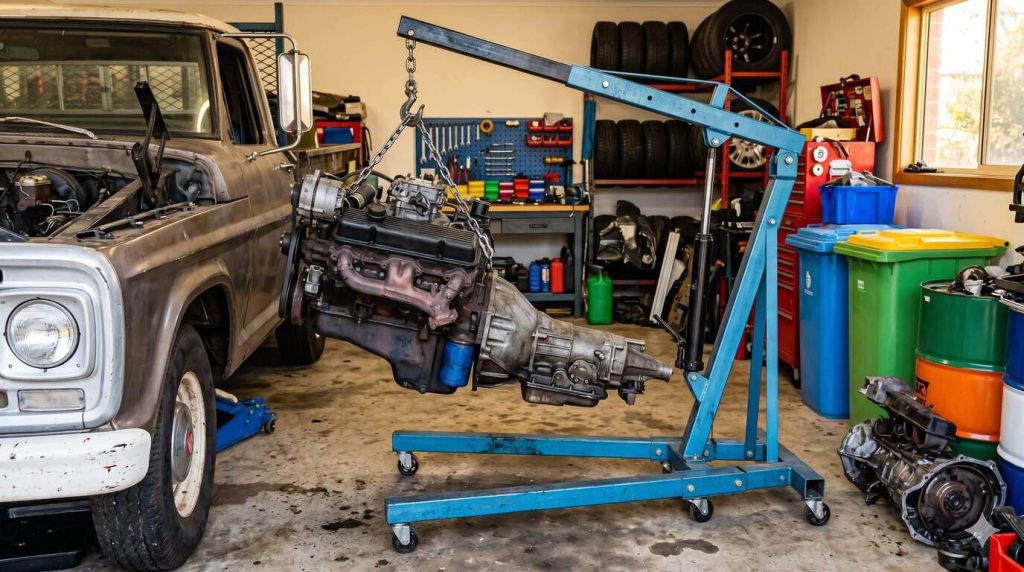
- Trusting the box sticker blindly: One cold Friday night, I fully trusted a shiny “2-ton” sticker on a new box. Big mistake. The label only tells you the absolute maximum under perfect conditions.
- Forgetting the boom arm extension: I pulled the heavy metal boom arm all the way out to reach a motor. The hoist groaned loudly. Your true lifting power drops fast when you extend that arm out.
- Ignoring the heavy extras: I once lifted a block but forgot to add the heavy iron manifolds, the thick fluids, and the huge gearbox bolted to the back. That hidden weight sneaks up on you fast.
- Buying small to save cash: We all want to save fifty bucks. I bought a tiny hoist first. Two months later, a buddy brought over his heavy SUV. I had to go to the store and buy the bigger model anyway. Do not pay twice.
- Forgetting about your floor space: A massive steel crane looks cool in pictures. But it is awful when you trip over its long legs every morning. I used to stub my toe and kick my hoist in total frustration just trying to reach my toolbox.
| The Mistake | What Actually Happens | The Easy Fix |
| Blind Trust | You push it too far and bend the steel arm. | Check the limit for the extended reach hole. |
| Ignoring Extras | The engine is way heavier than you guessed. | Always add an extra 20% to your weight math. |
| Going Cheap | You outgrow it and buy a second hoist later. | Buy the 2-ton model the very first time. |
| Ignoring Space | You trip over it in the dark every single day. | Buy a folding model with heavy-duty wheels. |
Quick Decision Guide (If You Just Want the Answer)
Are you standing in the parts store aisle right now? Or maybe you are scrolling on your phone on a late Thursday night? I have been exactly there.
My hands were covered in black grease. My brain hurt from reading confusing specs. I just stared at three heavy red boxes on the bottom shelf and sighed loudly. I was tired of guessing.
If you just want the fast answer to what size engine hoist do I need, here is your ultimate cheat sheet.
- Go 1-ton if: You only pull very small engines. You will rarely use it.
- Go 2-ton if: You want true versatility and peace of mind. ✅ It easily handles almost any home garage job.
- Go 3-ton if: You do heavy-duty work. You fix big diesel trucks.
Honestly, just grab the 2-ton model. I promise you will sleep much better knowing that thick steel arm will not snap under pressure.
| Hoist Size | Best Time to Buy | My Honest Verdict |
| 1-Ton | Tiny motors, rare use | A risky gamble. |
| 2-Ton | V8s, SUVs, safety | The smartest choice. |
| 3-Ton | Huge diesel trucks | Too clunky for home. |
Final Thought: Buy Once, Lift Confidently
There is nothing quite like that exact moment. You pump the handle slowly on a quiet Sunday evening. The greasy, heavy engine finally lifts completely out of the bay. There are no scary metal creaks. There is no sudden panic. Just a smooth, quiet float in the air. That feeling of total safety is exactly what you want.
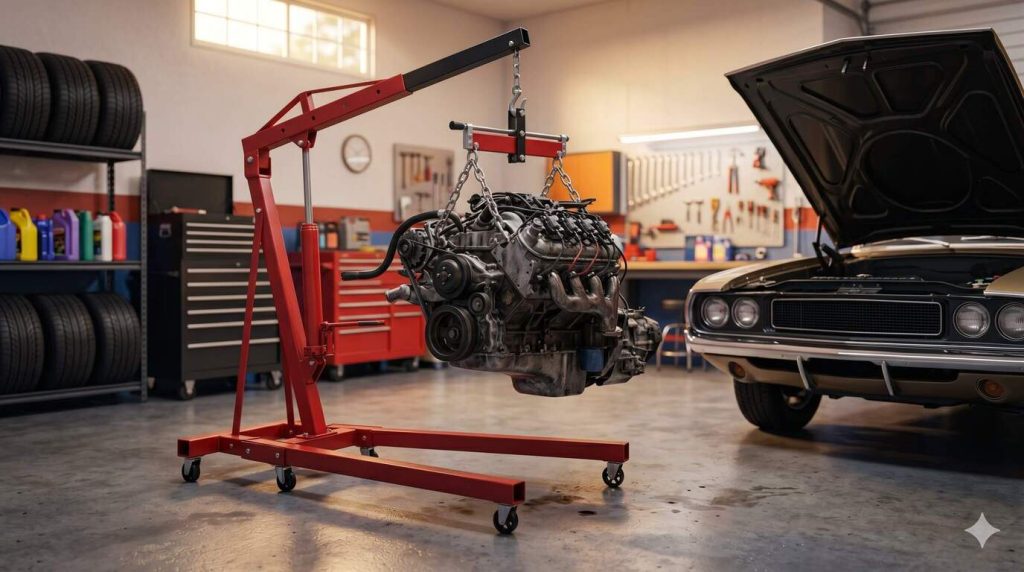
When you finally figure out exactly what size engine hoist do I need, you learn a very simple truth. Buying a slightly bigger lift changes everything about the job.
- It saves real time: You do not have to fight the short boom arm just to find the perfect lifting angle.
- It cuts down risk: Your toes, your oil pan, and your concrete floor stay safe from falling iron.
- It feels much better: You finish the whole job with zero stress and a totally normal heartbeat.
If you are still staring at your screen and feeling unsure, just choose the 2-ton model. It is the absolute safest bet for most folks. Buy it once. Lift safely the first time. Then, go wash off that black grease and admire your empty engine bay.
| The Golden Rule | Why It Matters | The Real Result |
| Buy once, cry once. | Cheap metal flexes and bends under pressure. | You keep your toes intact. |
| When in doubt, 2-ton. | It gives you safe, extra reach over the bumper. | A perfectly smooth engine pull. |
Frequently Asked Questions
Can I lift a heavy V8 motor with a smaller crane?
You might wonder is a 1 ton engine hoist enough for a V8. No, it is not safe. The heavy iron block will bend the metal arm. Always buy a bigger lift to stay safe in your garage.
Will a heavy-duty lift fit in my small shop?
When you ask what size engine hoist do I need, look at your floor. A huge lift takes up a lot of room. You should buy a folding model to save space and roll it away easily.
Does pulling the transmission change my math?
Yes, it does. When asking how big of an engine hoist do I need, add the gearbox weight. It adds a lot of heavy mass. You must step up to a two ton model for this big job.
Can I trust the max weight sticker on the box?
Do not trust the shiny sticker. The box only tells you the max lift with a short arm. When you pull the boom out, the power drops fast. Always read the manual to be very safe.
What happens if my lift is too weak for the car?
A weak lift is very bad news. The steel arm will bend and squeak loud. The hydraulic jack can blow a seal. You risk dropping the motor on the hard floor. Always go a bit bigger.