An engine hoist and a shop crane are usually the same tool: a folding, wheeled, hydraulic lift that most people also call a cherry picker. You roll it into place, pump the handle, and pull an engine. A gantry crane is a different animal. It is a taller, fixed overhead beam supported by two upright legs (an A-frame), and you hang a separate chain hoist from it to lift straight up. So the real choice is not three tools, it is two: a folding engine hoist for occasional engine work in a normal garage bay, or a gantry crane for repeated or heavier vertical lifting when you have the headroom and the floor space to give it.
That naming confusion is the single thing that trips up most buyers, so it is worth settling before you spend anything. If you have ever wondered whether “shop crane” and “engine hoist” are two products you need to compare, the answer is no. They are the same product with different labels on the box.
Why the names are a mess (engine hoist, shop crane, cherry picker)
Walk through any tool catalog and you will see the same folding hydraulic lift listed as an “engine hoist,” an “engine crane,” a “shop crane,” and a “cherry picker,” sometimes on the same page. These are marketing names for one design, not four different machines. Buyer guides from tool retailers say this plainly: the shop crane, the cherry picker, and the engine hoist are the same piece of equipment. The “cherry picker” nickname is borrowed from the fruit-picking lift it loosely resembles. If you want the full backstory on that name, we cover it in why engine hoists are called cherry pickers.
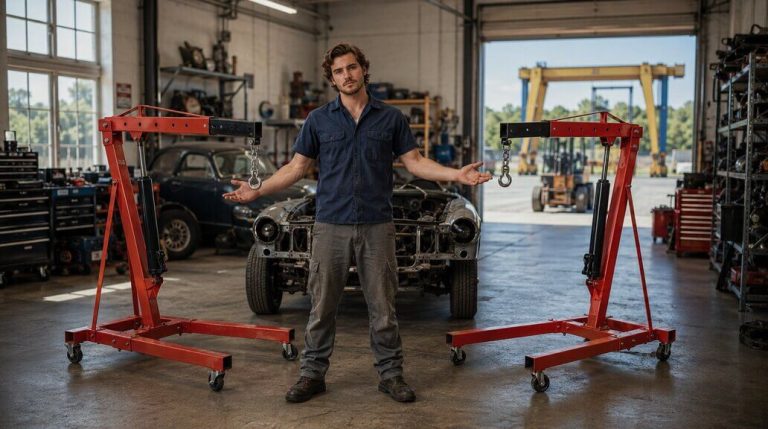
What actually matters is the mechanism, which is identical across all of them: a hydraulic ram (the same principle as a bottle jack) raises a long steel boom that extends out over your engine bay. We break down how that works in how an engine hoist works. Once you understand it is one tool with several names, the comparison gets simple.
A gantry crane, on the other hand, is genuinely a separate category. It does not fold, it does not have a hydraulic ram of its own, and it is not something you roll out to the driveway on a whim. That is the comparison worth making.
Where a gantry crane is a genuinely different tool
A gantry crane is an overhead beam held up by two legs, forming an A-frame or a portal shape. The lift itself comes from a chain hoist or a trolley that hangs from the beam, so you are always lifting straight down from a fixed high point. Because the beam spans a fixed distance, you can move a load sideways along it, not just up and down, and you can lift anything that fits under it: an engine, a transmission, a differential, a heavy tool, an outboard motor, a lump of steel. It is not engine-specific.
That is the whole appeal. A folding engine hoist has to straddle its load with its legs and reach out with a boom, and the farther the boom reaches, the less it can safely lift. A gantry crane lifts vertically from directly above, which is more stable and gives you cleaner, more controlled fine adjustment when you are trying to line up bell-housing bolts by fractions of an inch. For a shop that lifts heavy things often, that control and versatility is worth the space it eats.
The comparison table
Here is the honest side-by-side. Treat every rating as “check the plate on the actual unit,” because capacity varies widely by model.
| Factor | Folding engine hoist (shop crane / cherry picker) | Gantry crane |
|---|---|---|
| Mobility | Rolls on casters, folds flat, fits in a truck bed | Semi-fixed; portable aluminum models exist but most stay put once built |
| Capacity range | Commonly 1 to 2 tons, but pro-rated: a “2-ton” hoist can drop to around 1/2 to 1 ton at full boom extension | Very wide, from light portable units up to multi-ton fixed steel frames; set by the beam and the hoist you hang on it |
| Reach and lift height | Boom reaches out over the bay; lift height often runs from near-floor to roughly 78 to 93 inches at the hook, depending on boom position | Lifts straight up to just under the beam; height is fixed by how tall you build the frame, and you can move loads along the whole beam span |
| Storage | Folds against a wall in minutes; small footprint when stowed | Needs permanent floor and overhead space; does not fold away |
| Best use | Occasional engine pulls, one-bay garages, anyone who wants the tool gone when the job is done | Frequent lifts, heavy or awkward loads, workshops with the space and headroom to leave it standing |
| Cost tier | Entry-level to mid; the affordable default | Mid to premium, rising fast with span and capacity |
The one line to burn into memory: an engine hoist’s rating shrinks as the boom extends. That “2-ton” sticker applies at the shortest boom setting. Reach out far enough to clear a long hood or a truck’s engine, and the safe capacity can fall to a fraction of the headline number. We go deeper on that trap in what size engine hoist you need.
Space is the deciding factor for most home garages
Ignore capacity for a second, because for most home engine jobs either tool has enough. The real deciding factor is floor space and headroom.
A folding engine hoist is built for the person who has one garage bay and needs it back. It comes in wheels-up, you use it, you fold it flat, and it leans against the wall until the next job. That is the entire reason it exists in this shape.
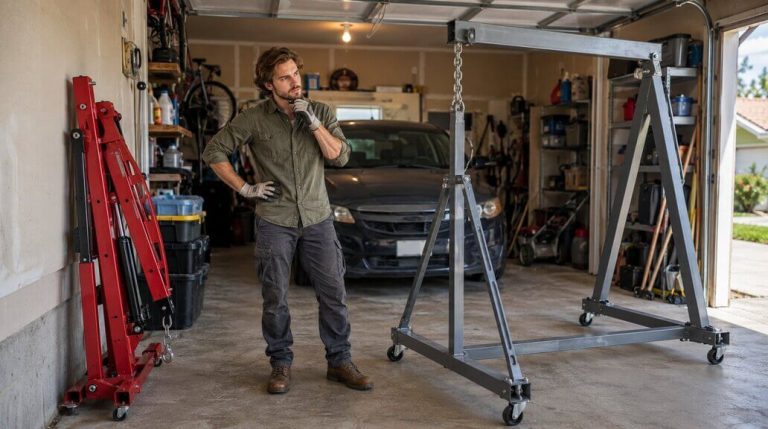
A gantry crane assumes the opposite. It wants clear floor for its two legs, clear overhead for its beam, and it wants to stay assembled. The most common complaint from people who buy one for a home garage is not that it lifts poorly, it is that the frame is always in the way. If your garage doubles as parking, storage, and a workbench, a standing A-frame is a daily obstacle. If you have a dedicated workshop with a high ceiling and a corner to spare, it is a joy.
So before you compare lift ratings, measure your ceiling and look at your floor honestly. That answer decides more than the spec sheet does.
Portability and setup time
An engine hoist is close to grab-and-go. Unfold the legs, pin the boom, attach a load leveler or chain, and you are lifting. When you are done it folds back down and disappears.
A gantry crane is a build, not an unfold. Even portable aluminum models take assembly, and steel ones are effectively permanent once up. You are trading setup convenience for the stability and reach you get in return. If you lift once a year, that trade rarely makes sense. If you lift every week, the gantry is already standing there waiting, which is its own kind of convenience.
Which one for your situation
A short decision list, not a hard sell:
- You are pulling one engine, maybe once or twice ever, in a normal garage: buy a folding engine hoist. It is the right tool and, honestly, the only one you need. Match the capacity to your engine plus a safety margin, and remember the boom-extension penalty.
- You run a busy home shop and lift engines, transmissions, and heavy parts often: a gantry crane starts to earn its space. The vertical lift and the ability to slide a load along the beam save time and give you more control on repeat jobs.
- You lift genuinely heavy or awkward loads, or you need to move a load sideways, not just up: the gantry wins on stability and versatility, provided you have the headroom.
- You are tight on space or unsure: default to the folding hoist. It folds away, costs less, and covers the overwhelming majority of home-garage engine work.
Once you have picked a hoist, our best engine hoist for a home garage buying guide walks through capacity, boom rating, caster quality, and the specs that actually matter.
The part most comparisons skip
Here is what the “vs” articles rarely say out loud: for the large majority of home mechanics, a folding engine hoist is not just the better choice, it is the only tool you need, and a gantry crane would be an expensive answer to a question you do not have. Gantry cranes are excellent, but they are aimed at fixed workshops with headroom and frequent, heavy lifting. Buying one for a once-a-year engine swap in a shared garage bay is a common and costly mismatch.
The second honest point is the naming confusion itself. A lot of buyers waste time comparing a “shop crane” against an “engine hoist” as if they were rivals, when they are the same tool. That confusion pushes people toward gantry cranes they do not need, because they assume “gantry” is simply the next step up from “engine hoist,” when really it is a sideways move into a different use case.
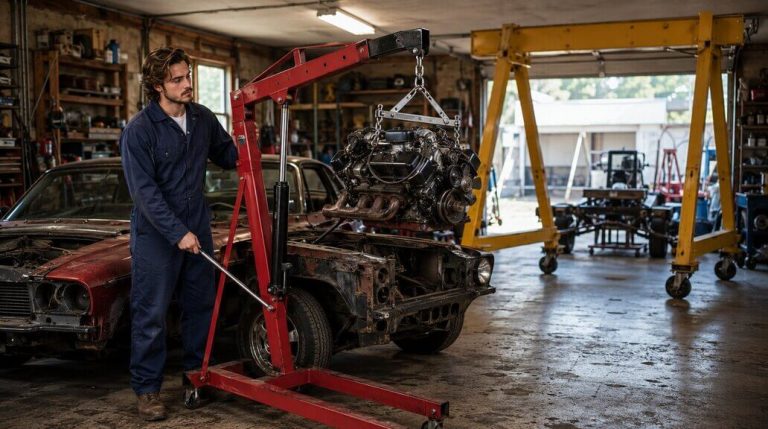
And a maintenance note that catches people off guard: an engine hoist is a hydraulic tool, and hydraulics can lose pressure over time or sit poorly after storage. If yours starts sagging under load, that is a fixable seal or fluid issue, not a reason to distrust the whole category. We cover it in engine hoist losing pressure troubleshooting. Whichever tool you land on, read up on rigging and load safety first; our how to use an engine hoist safely guide covers straddling the load, chain angles, and why you never stand under a raised engine.
FAQ
Is a shop crane the same as an engine hoist?
Yes. “Shop crane,” “engine crane,” “engine hoist,” and “cherry picker” are all names for the same folding hydraulic lift. There is no meaningful difference between them; it is one tool with several marketing labels.
Is a gantry crane better than an engine hoist?
Not universally. A gantry crane is more stable and more versatile for heavy or repeated vertical lifts, but it needs permanent floor and overhead space. For occasional engine work in a normal garage, a folding engine hoist is easier, cheaper, and enough.
Does an engine hoist really lose capacity when the boom extends?
Yes, and this is critical. Capacity is pro-rated by boom position. A hoist rated at 2 tons fully retracted can drop to roughly 1/2 to 1 ton at full extension. Always check the rating for the boom position you will actually use.
Can a gantry crane pull a car engine?
Yes. Hang a chain hoist from the beam and it lifts an engine cleanly, often with better control than a folding hoist. The catch is space: the frame has to stay standing, and you need headroom clear above the vehicle.
Which one is best for a first-time home mechanic?
A folding engine hoist. It handles almost every home engine job, folds flat for storage, and costs less. Reach for a gantry crane only if you lift heavy loads often and have a dedicated workshop with the room to keep it up.