There is no single correct answer to lifting plate versus chain versus load leveler, because the right choice depends on what lift-point provisions your specific engine actually has, not on which tool is generally “better.” All three connect your hoist’s hook to the engine, but they do it differently, and the right one for your job is the one that matches your engine’s factory lift points and the tilt control your removal actually needs.
What each tool actually is
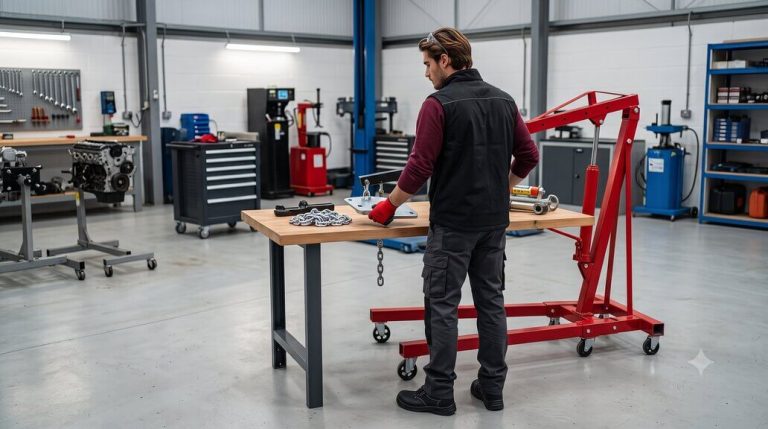
A lifting plate is a flat bracket that bolts to the top of the engine, historically at the intake manifold or carburetor mounting studs on many older engines, giving the hoist hook a single, centered attachment point. A chain is exactly what it sounds like: a length of rated chain looped or hooked to two or more points on the engine, giving you flexibility to choose your own attachment points where a plate will not fit or where the engine has no dedicated mounting provision for one. A load leveler is a bar, typically with two chains and a crank or adjustable mechanism, that lets you tilt the engine nose-up or nose-down in the air, which matters because an engine almost never balances level from a single point.
Lifting plates: what they’re for and their limits
Lift plates are most associated with older carbureted engines, where the intake manifold or carburetor studs provide a natural, centered mounting point already close to the engine’s balance point. Their appeal is simplicity: one bracket, one hook point, no fussing with multiple chain lengths.
Their limit is that they depend entirely on the specific mounting points being rated and intended for that use. Not every engine has a factory-documented lift point at its intake or manifold, and bolting a plate to fasteners or a component never intended to carry the engine’s full weight is exactly the kind of shortcut that leads to a dropped load. Whether a specific bolt pattern is an appropriate lift point for your engine is a question for your engine’s own service documentation, not a general assumption based on how older engines are commonly rigged.

Chains: flexibility, and the one rule that doesn’t bend
Chains give you the flexibility to rig from wherever your engine actually has documented lift points, rather than being limited to wherever a plate happens to bolt on. This makes chains the more universal choice across engine types, old and new, and they are frequently used alongside a lifting plate or a load leveler rather than instead of one.
The rule that does not bend: any chain, hook, or shackle used to lift an engine must be rated for the load, with real margin, and that rating must come from a tag or stamp on the hardware itself, never a guess. A chain that “looks stout enough” is not a rated chain. If you do not know a piece of rigging hardware’s rated capacity, do not use it to lift an engine. This is not a place to estimate.
Load levelers: when tilt control is worth it
A load leveler earns its cost when you are lifting an engine and transmission together, or pulling an engine through a bay where clearing the firewall, radiator support, or a transmission hump requires tilting the load rather than lifting it dead level. Because a leveler typically uses two independently adjustable chain points, it lets you tip the load without unhooking and re-rigging, which single-chain setups cannot do without extra effort and extra time with a load in the air.
For a straightforward engine-only pull with a natural balance point, a leveler is often more capability than you strictly need. For anything requiring tilt during removal or installation, it is worth the cost. Our dedicated engine hoist leveler buying guide covers how to choose one once you’ve decided you need the tilt control.
Finding your engine’s actual lift points
This is the step every generalist comparison skips, and it is the one that actually determines which rigging method is correct for you. Your engine’s factory-documented lift points, wherever they are on your specific engine, are the only locations that have been engineered and rated to carry the engine’s weight during removal. Guessing at a plausible-looking bolt pattern, or copying what worked on a different engine in a forum post, is not a substitute for checking your vehicle’s service manual for the documented lift points on your specific engine.
If your service documentation does not clearly identify a lift point, or you are not confident in what you are reading, stop and get help from someone qualified before rigging the lift, rather than proceeding on a best guess.
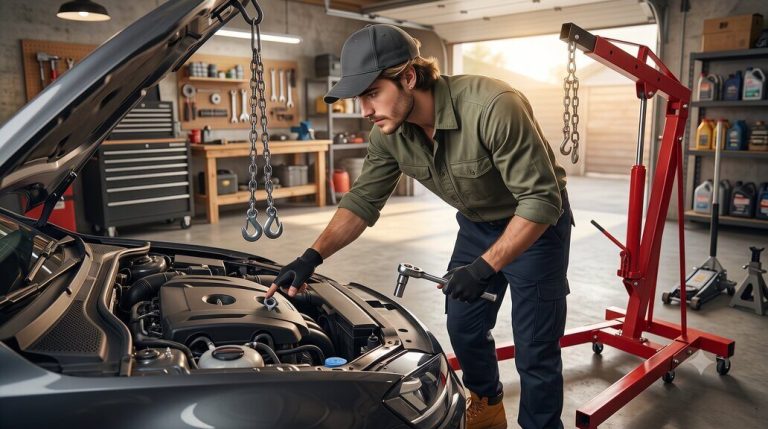
The rule that never changes regardless of which you use
Whichever combination of plate, chain, and leveler your job calls for, three things hold every time: rig only to factory-documented lift points, use hardware rated for the load with real margin above your engine’s actual weight, and never put any part of your body under the engine once it is suspended, however it is rigged. Boom position also affects how much capacity margin you actually have at the moment of the lift. See our explainer on boom extension capacity if you have not already accounted for that. For the complete procedure beyond rigging, see our safety checklist.
Which to choose for your situation
- Engine only, natural balance point, documented single-point provision: a lifting plate is usually the simplest choice.
- No single-point provision, or rigging from multiple documented points: rated chain, sized and inspected before use.
- Engine and transmission together, or a bay that requires tilting to clear: a load leveler, on top of whichever chain or plate attachment your lift points call for.
- Any doubt about your engine’s lift points: stop and check the service manual, or get qualified help, before rigging anything.
Frequently asked questions
Can I use a lifting plate on any engine?
Only if your specific engine has a factory-documented mounting point, such as intake or carburetor studs on many older engines, that is rated to carry the engine’s weight. Check your service documentation rather than assuming a bolt pattern that worked on a different engine will work on yours.
Is a chain safer than a lifting plate?
Neither is inherently safer. Safety comes from rigging to your engine’s actual documented lift points with hardware rated for the load, regardless of whether that hardware is a chain or a plate.
Do I need a load leveler for every engine pull?
No. A leveler is most valuable when you are lifting an engine and transmission together or need to tilt the load to clear part of the bay. A straightforward engine-only pull with a natural balance point often does not need one.
How do I know if my chain is rated for my engine’s weight?
Check the manufacturer’s rating tag or stamp on the chain and hardware itself, and compare it against your engine’s actual documented weight with real safety margin. Never estimate a chain’s capacity by its appearance.
Where do I find my engine’s factory lift points?
In your vehicle’s service manual or equivalent factory documentation. If you cannot locate a clear lift point for your specific engine, stop and get qualified help rather than guessing at a mounting location.