A low-profile floor jack solves one specific problem: not enough clearance under the car to get a standard jack in position. If your car has stock ground clearance, that problem does not apply to you, and a low-profile jack is not buying you anything except a lower reach you don’t need, usually at a higher price. The decision comes down to one measurement at your own vehicle’s actual jacking point, not to what kind of car you drive in general. Whichever jack fits, remember it only raises the car; our complete safe-lifting guide covers what holds it once it’s up.
Direct answer: measure your clearance first
Before deciding anything, measure the clearance at your vehicle’s actual jacking point in its normal resting position, not the ground clearance at the lowest body panel. If a standard jack, which typically starts around 3.5 to 4 inches at its lowest saddle height, can already slide under that point, a low-profile jack solves a problem you do not have. If it cannot, that is the specific case a low-profile jack exists for.
What “low profile” actually means
Low profile refers to the jack’s minimum saddle height, the height of the lifting pad in its fully lowered position, not the overall size or footprint of the jack. Standard jacks generally start around 3.5 to 4 inches off the ground. Low-profile jacks are built to start lower, with options ranging roughly from 2.75 inches (aimed at heavily modified or very low sport-tuned vehicles) up to around 3.75 to 4 inches for some standard low-profile models, depending on the specific jack.
Who genuinely needs one
A low-profile jack earns its keep if your vehicle is a sports car, a lowered car, or has aftermarket suspension that dropped its ride height, or in some cases a newer crossover with unusually tight clearance at the front jacking points. In these cases, a standard jack physically cannot slide under the rocker panel to reach the jacking point at all, and there is no workaround except a jack built to start lower.
Who doesn’t
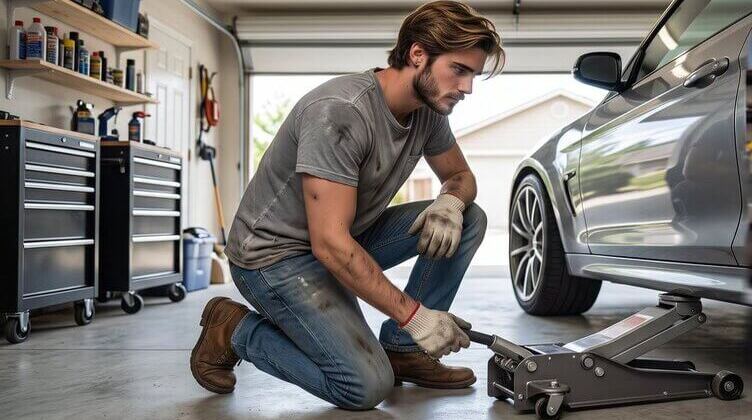
If you drive a stock-height sedan, SUV, or truck, a standard floor jack already reaches your jacking points without issue in the overwhelming majority of cases. Buying a low-profile jack in this situation typically costs more for a capability you will not use, and depending on the specific model, it may trade away some maximum lift height to achieve that lower starting point, which is a real tradeoff worth knowing about before you pay for it.
How to check your own car in five minutes
Locate your factory jacking points (from your owner’s manual), then measure the actual clearance from the ground to that specific point with the car in its normal resting stance, not an estimate based on how low the car looks. Compare that number to the minimum saddle height listed for the standard jack you are considering. If there is comfortable clearance, a standard jack works. If the clearance is tight or the jack you are considering will not fit, that is when a low-profile model becomes worth the extra cost.
The tradeoff if you buy one anyway
Some low-profile jacks achieve their lower starting height at the cost of a lower maximum lift height for the same overall footprint, compared to a standard jack of similar rated capacity. If you buy low-profile without needing it, you may end up with less maximum lift range than a standard jack would have given you, for a clearance advantage you never use. Our piece on the three measurements to check before buying any floor jack covers minimum height, maximum lift, and the margin you actually need in more detail, and is worth reading alongside this one regardless of which style you land on. If you are still deciding between materials as well, our aluminum vs steel comparison covers that separate decision.
The “long arm” design some low-profile jacks use
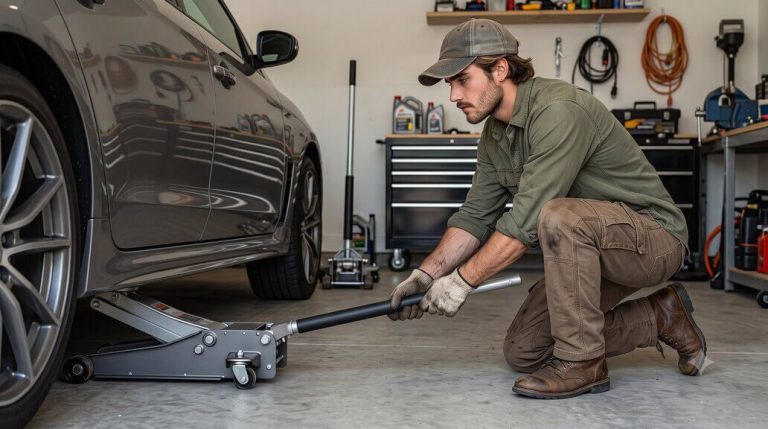
A number of low-profile jacks reach their reduced saddle height with a longer main arm and lifting pad extended further forward from the frame, rather than only shrinking the frame itself. This design lets the jack slide further under a vehicle before reaching the jacking point, which is genuinely useful on low-clearance cars, but it also means the jack’s overall footprint can be longer than a standard jack’s. If your garage floor space or the layout around your car is tight, that longer reach is worth checking before you buy, alongside the height numbers.
One car in the household, one truck: do you need two jacks?
A household with both a lowered or sports car and a stock-height truck or SUV genuinely may need a low-profile jack for one vehicle and get little use out of it on the other, since a low-profile jack’s shorter minimum height does not prevent it from also working on a taller vehicle, but its typically shorter overall lift range can make it a worse fit there than a standard jack would be. In that situation, buying specifically for the lower car and accepting the tradeoff on the taller one is a reasonable call, or keeping both a standard and a low-profile jack on hand if the budget allows for it.
Renting instead of buying for one job
If the only reason you need a low-profile jack is a single one-off task, such as helping a friend with a lowered car for an afternoon, some tool rental counters and auto parts stores offer loaner or rental jacks that make more sense than buying a jack you will rarely use again. This is worth considering before committing to a purchase that will otherwise sit unused in your own garage.
A quick way to sanity-check a listing before you buy
Once you have your own measurement, compare it directly against the specific jack’s stated minimum saddle height on the manufacturer’s own product page, not a marketplace listing’s summary or a generic “fits most cars” claim. Listings sometimes round the minimum height down or omit it entirely in favor of highlighting maximum lift or rated capacity, so if a listing does not state a clear minimum height number, treat that as a reason to look elsewhere rather than assume it will work.

Frequently asked questions
Does a low-profile jack lift higher than a standard jack?
Not necessarily, and often the opposite. Some low-profile models trade some maximum lift height for their lower starting height, within a similar footprint. Check the specific jack’s stated maximum, not just its minimum.
My car isn’t lowered, but it’s a newer crossover. Do I need one anyway?
Some newer crossovers do have unusually tight clearance at their front jacking points even without aftermarket lowering. Measure your actual clearance rather than assuming based on the vehicle’s general category.
Is a low-profile jack ever a bad choice even for a low car?
It’s rarely a bad choice for a genuinely low car, since it may be the only jack that physically fits. The caution is mainly for stock-height vehicles buying one unnecessarily.
How do I measure my car’s actual jacking-point clearance?
Locate the factory jacking points in your owner’s manual, then measure the ground clearance at that specific point with the car resting normally, not at the lowest visible body panel.
Do low-profile jacks cost more than standard ones?
Generally, yes, for a comparable rated capacity, reflecting the more specialized design needed to achieve the lower profile.